Lift chair weight capacity ranges from 300 lbs on standard models to 500-700 lbs on bariatric and heavy-duty frames, and the number that matters is your actual weight plus a 10-20% buffer, not the chair's advertised maximum. The hidden catch: seat width and depth have to scale with capacity too, so a 500 lb-rated chair with a narrow 20-inch seat can still feel wrong for a larger frame.
- A lift chair weight capacity guide starts with your body weight plus a 10-20% buffer, not the chair's max rating.
- Standard lift chairs top out around 300 lbs; heavy-duty and bariatric models run 500-700 lbs.
- Seat width and depth need to match the capacity tier, or a high-rated chair still fits poorly.
- Exceeding the rated limit strains the lift motor and can keep the chair from reaching a full standing position.
- Edward Creation lists capacity-specific guides for oversized, petite, and stability-focused lift chairs.
Why this matters
A lift chair that's underrated for the user's weight won't just wear out faster, it can fail to complete the lift cycle altogether, leaving someone stuck halfway to standing. That's a fall risk, not a comfort issue.
Going the other direction, an oversized frame bought "just in case" for a petite or average-weight user often sits too deep or too wide, forcing awkward posture and poor back support. Matching capacity to actual body weight, not the biggest number on the spec sheet, is the whole game in 2026.
Edward Creation's full lift chair catalog breaks models out by capacity tier, which is the fastest way to narrow the field before you start comparing recline styles or fabric.
How to choose the right lift chair weight capacity
Start with the user's current weight, not their weight from a few years ago. Add 10-20% as a buffer for clothing, seasonal weight changes, and the extra stress of daily lift cycles rather than occasional use.
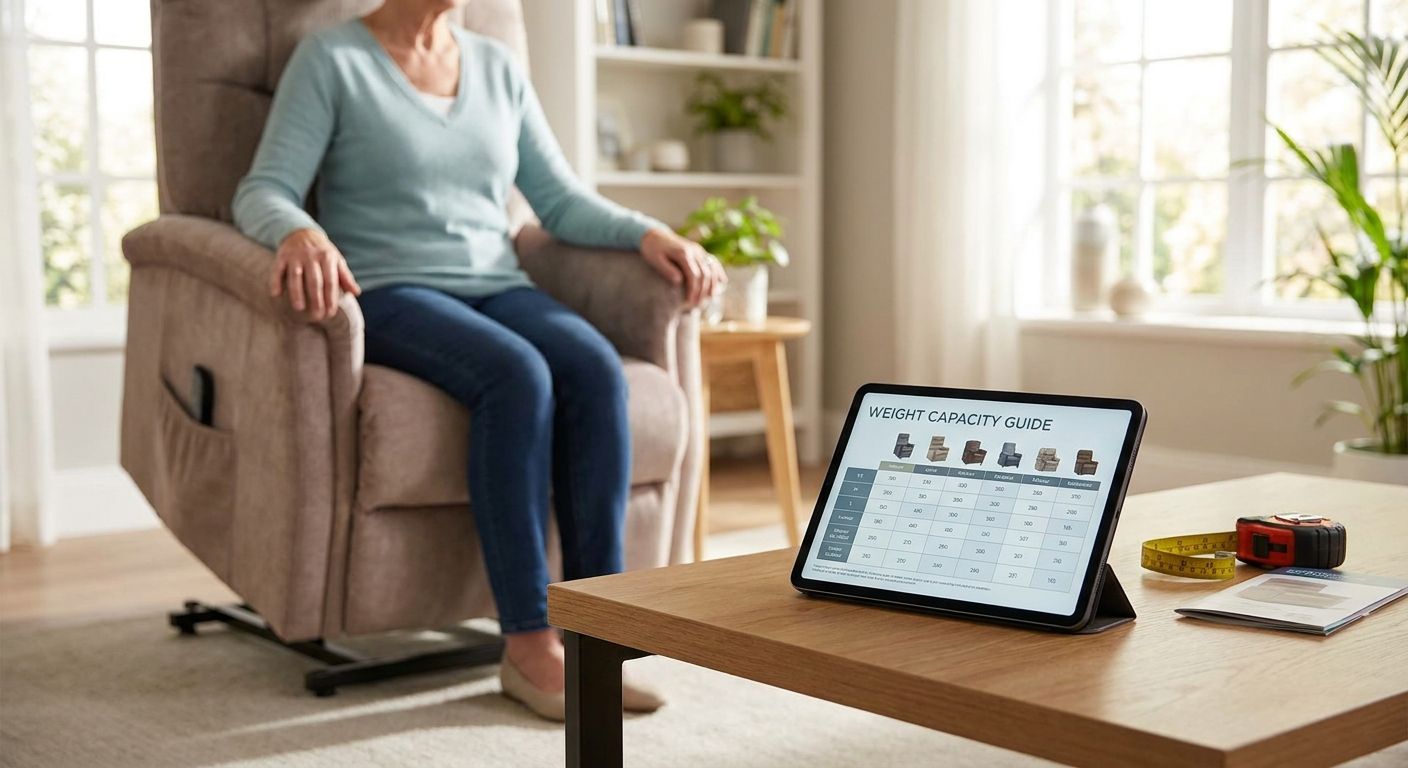
| Capacity tier | Typical range | Best for |
|---|---|---|
| Standard | Up to 300 lbs | Average-frame adults with no anticipated weight change |
| Heavy-duty | 350-500 lbs | Larger-frame users or those needing extra frame reinforcement |
| Bariatric | 500-700 lbs | Big and tall users needing maximum stability and wider seating |
If the user's weight sits within 20 lbs of a tier's ceiling, size up rather than buy at the limit. A chair used daily for standing assistance takes more cumulative stress than one used occasionally, and manufacturers rate capacity for steady, safe operation, not the absolute breaking point.
“If you're within 20 pounds of a lift chair's rated maximum, size up to the next capacity tier instead of buying at the limit.”
Standard capacity: up to 300 lbs
Most lift chairs sold for general home use in 2026 carry a roughly 300 lb capacity rating. These frames use single-motor lift mechanisms and standard-gauge steel, which keeps the chair lighter and easier to fit into typical living rooms.
- Pros: Lower profile, easier to move, fits standard-width doorways and rooms.
- Cons: Not built for users near or above the rated limit; less frame reinforcement.
- Best for: Average-weight adults with stable weight expectations. Buy.
Heavy-duty capacity: 350-500 lbs
Heavy-duty lift chairs step up to reinforced frames, wider seat bases, and often stronger single or dual-motor systems. They're the middle ground for users who don't need full bariatric sizing but want more margin than a standard-rated chair offers.
- Pros: Reinforced welds and wider seating without bariatric-scale bulk.
- Cons: Bulkier footprint than standard models; fewer fabric and color options in some lines.
- Best for: Larger-frame users or households wanting a safety margin above 300 lbs. Buy.
Bariatric capacity: 500-700 lbs
Bariatric lift chairs are purpose-built for big and tall users, with wider seat depth, reinforced steel frames, and motors rated for the added load and daily cycling. Edward Creation covers this category directly in its oversized lift chair guide for big and tall users.
- Pros: Highest stability margin, wider and deeper seating, reinforced base.
- Cons: Larger footprint, heavier chair overall, fewer compact-room options.
- Best for: Big and tall users needing maximum rated capacity. Buy.
Why lift chair weight capacity varies
- Frame material and welds — reinforced steel frames handle more cumulative stress than lighter-gauge standard frames.
- Motor and actuator strength — single-motor systems are typically rated for lower capacities than dual-motor designs.
- Seat width and depth — a wider, deeper seat spreads weight more evenly across the frame.
- Base and leg design — wider bases resist tipping at higher capacities.
- Intended use frequency — chairs rated for daily lift-assist cycles carry more conservative ratings than occasional-use furniture.
- Manufacturer testing standards — ratings reflect each brand's own load testing, so two chairs with the same listed capacity can still feel different in daily use.
Users with balance concerns alongside weight considerations should also look at chairs built for extra stability, covered in the weighted lift chairs for extra stability guide.
Does weight capacity affect motor strength?
Yes — higher-capacity chairs generally pair with stronger single motors or dual-motor systems built to lift heavier loads smoothly. A 300 lb-rated chair's motor isn't engineered for the repeated strain of lifting near a bariatric-range weight, even if it could technically move it once or twice.
What happens if you exceed a lift chair's weight limit?
Exceeding the rated weight limit puts extra strain on the motor and frame, and the chair may fail to reach a full standing position or stall mid-lift. Over time this also shortens the working life of the lift mechanism, since it's operating outside its designed load range on every cycle.
Is there a lift chair weight capacity guide for petite users?
Petite and small-frame users generally do better with narrower, shallower seat dimensions rather than a high-capacity frame sized for a larger body. Edward Creation's best lift chairs for petite and small-frame seniors guide covers seat sizing separately from weight capacity.
Find your capacity tier
Browse lift chairs by weight capacity and seat size before you decide.
FAQ
What is a normal lift chair weight capacity?
Most standard lift chairs sold in 2026 carry a weight capacity around 300 lbs. Heavy-duty and bariatric models extend that range up to 500-700 lbs for larger users.
How much weight capacity buffer should I add?
Add a 10-20% buffer above the user's current weight rather than buying exactly at the rated limit. This accounts for clothing, seasonal weight shifts, and daily lift-cycle stress.
What is the weight capacity of a bariatric lift chair?
Bariatric lift chairs typically range from 500 to 700 lbs. These frames use reinforced steel and wider seat bases built for the added load.
Does a higher weight capacity mean a bulkier chair?
Generally yes — heavy-duty and bariatric frames use reinforced steel and wider seat bases, which adds to the overall footprint compared to standard 300 lb-rated chairs.
Can a petite user sit comfortably in a high-capacity lift chair?
A high-capacity chair can support a petite user's weight easily, but the wider, deeper seat built for bariatric sizing often fits poorly. Seat width and depth matter as much as capacity for petite frames.
What happens if you exceed a lift chair's rated weight limit?
Exceeding the rated limit strains the motor and frame, and the chair can stall or fail to reach a full standing position. It also shortens the working life of the lift mechanism over repeated use.
Is weight capacity the same as motor lifting power?
They're related but not identical — motor lifting power is engineered to match the chair's rated capacity, so higher-capacity chairs generally pair with stronger single or dual-motor systems.
One last thing
The number on the spec sheet is a ceiling, not a target — the chairs that hold up best in daily use in 2026 are the ones bought with a buffer, not at the rated limit. If the user's weight sits close to a tier boundary, the seat width and depth comparison matters just as much as the capacity number itself.