
Setting up a lift chair for a loved one with dementia works best when you strip the decision down to three things: a fixed, familiar spot in the room, one button instead of five, and a battery backup so nobody gets stranded mid-recline during a power blip. The chair itself rarely causes the trouble — the extra buttons, moving parts, and unfamiliar controls do.
- A lift chair for dementia patients setup starts with a fixed room location and a single-button remote, not extra features.
- Battery backup matters more here than in a standard setup — a stalled recline mid-cycle can trigger real panic in someone with dementia.
- Edward Creation stocks lift chairs with simple lift-and-recline motion that work better for cognitive decline than heat/massage models with multiple settings.
- Placement, lighting, and a caregiver check-in routine matter as much as the chair's specs in 2026.
Why this matters
A standard lift chair setup guide assumes the user can read a remote, remember a sequence, and troubleshoot a stuck recline. None of that holds for dementia. The same multi-position controls that a spinal stenosis patient appreciates become a source of anxiety for someone who can't remember which button does what.
Getting the wheelchair to lift chair transfer routine consistent is part of this too — dementia caregivers report that changing the transfer method mid-week confuses patients more than almost anything else in daily care. Setup isn't just where the chair sits; it's the whole routine around it.
How do you set up a lift chair for a loved one with dementia?
Follow this order, not the order in the manufacturer's manual:
- Pick one spot and never move the chair. Same room, same orientation to the TV or window, every single day of 2026.
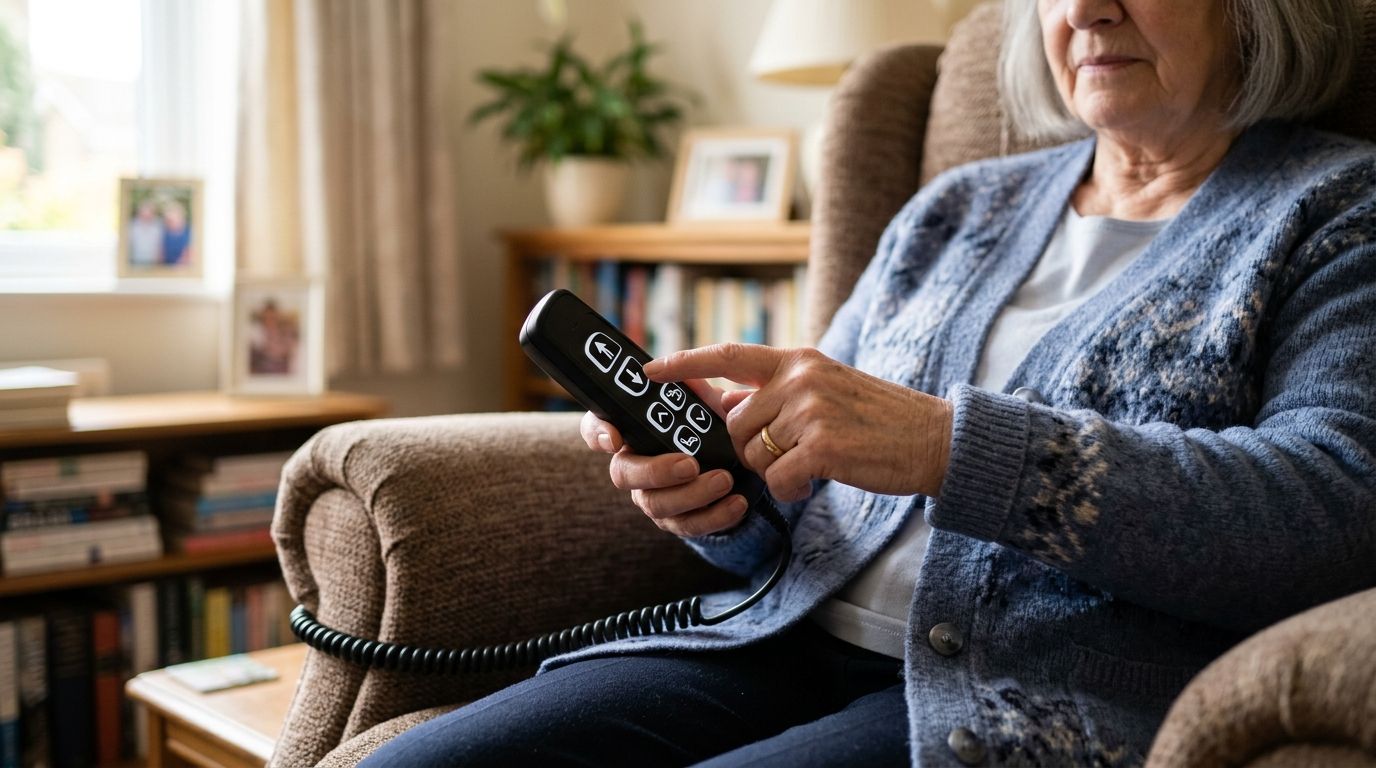
- Test the remote before the patient ever touches it. If it has more than lift, recline, and stop, cover the extra buttons with tape.
- Set the recline to two fixed positions only — upright for sitting, one recline angle for rest. Skip the in-between settings entirely.
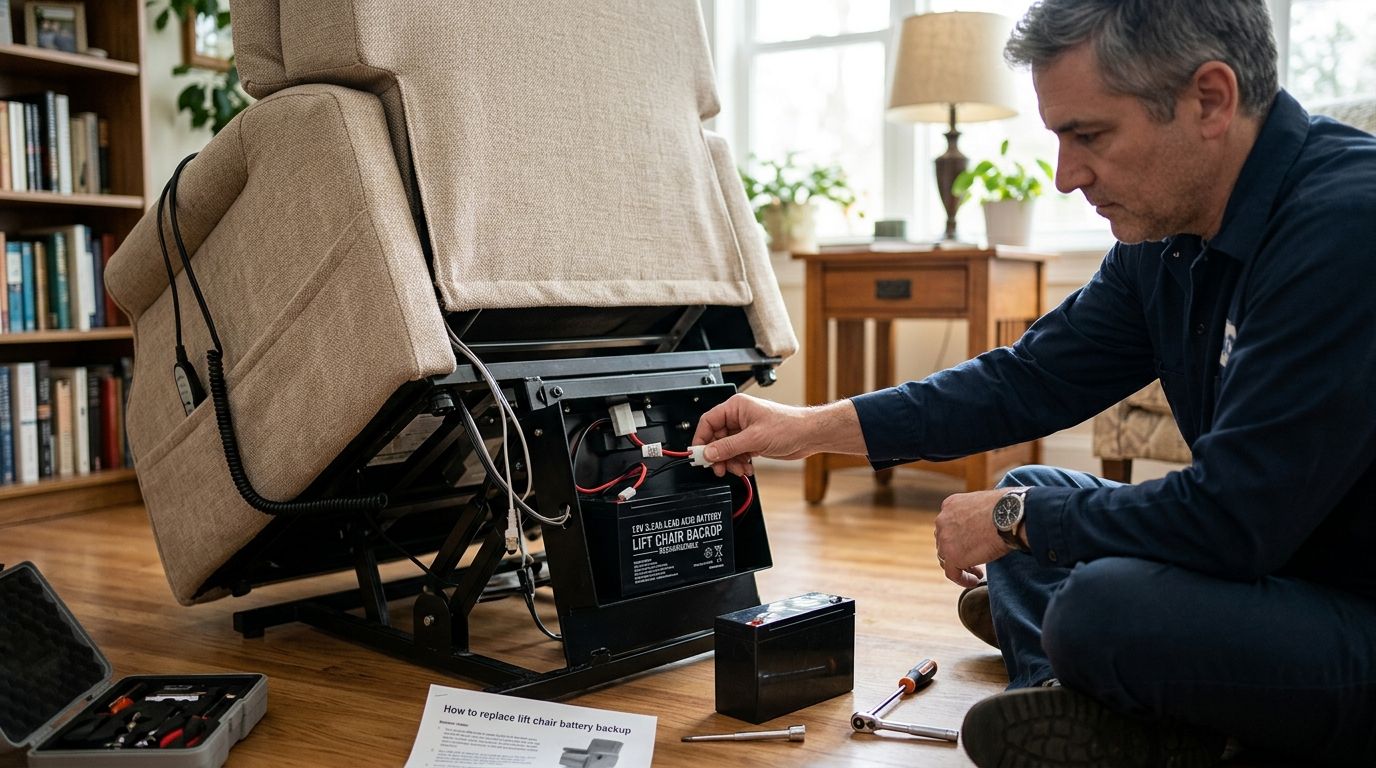
- Plug into an outlet near a battery backup, not a shared power strip that gets unplugged for vacuums or space heaters.
- Walk through the stand-up motion with the patient at least once a day for the first two weeks so the motorized lift becomes familiar rather than startling.
- Add a caregiver check-in routine at the chair — this is where a calming or reminder device earns its place, not as an accessory but as part of the setup itself.
Placement decides whether the chair gets used
A lift chair placed in an unfamiliar room, or one that gets rearranged, often sits unused within a month for a dementia patient. Keep it in the room where the person already spends most of their day — usually near a window or the main living space — and keep the same lamp, same side table, same sightline to the door.
Don't place it near a walkway that requires navigating around furniture; dementia patients lose spatial judgment first, and a cluttered path to the chair is a fall risk before the chair ever gets used.
One button beats five every time
Every extra function on a lift chair remote — heat, massage, multiple recline stops, headrest adjustment — is a decision point a dementia patient has to process. Multiply that by every use and you get hesitation, frustration, and sometimes a call for help that didn't need to happen.
The fix is mechanical, not clinical: cover unused buttons with a strip of tape, or choose a lift chair model with a simpler two-function remote from the start. The goal in 2026 is fewer choices, not more comfort settings.
A battery backup is not optional
A lift chair that stalls halfway through a recline cycle during a power outage is unsettling for anyone — it's disorienting and sometimes frightening for someone with dementia who can't reason through what's happening. A backup battery, like a 2500 mAh unit rated for 590+ recline cycles, keeps the chair finishing its motion even when the outlet goes dark.
This is the single most overlooked step in lift chair for dementia patients setup, and it costs almost nothing to add compared to the anxiety it prevents.


Why lift chair setup varies for dementia patients
No two dementia setups look identical because the details below shift the whole plan:
- Stage of dementia — early-stage patients may still manage a simple remote; later-stage patients need caregiver-only control.
- Home layout — a chair in a shared living room needs different placement rules than one in a private bedroom.
- Presence of a live-in caregiver — around-the-clock supervision changes how much independence the setup allows.
- Other mobility conditions — arthritis, balance disorders, or prior falls change transfer technique and chair positioning.
- Wandering behavior — some dementia patients get up repeatedly; the chair location should stay clear of high-traffic exit paths.
- Vision changes — low lighting near the chair increases fall risk independent of the chair itself.
Caregivers managing a parent with both dementia and balance issues often start with the guidance on lift chairs for balance disorders before finalizing placement, since the two setups overlap heavily.
Is a lift chair safe for someone with dementia?
A lift chair is safe for someone with dementia when the remote is simplified to one or two functions and the chair sits in a consistent, familiar location. The risk isn't the mechanism — it's confusion from too many settings or a chair that gets moved around the room.
Can a person with dementia operate a lift chair alone?
Whether a person with dementia can operate a lift chair alone depends on the stage of the condition, not the chair's features. Early-stage patients often manage a single lift-and-recline button fine; mid-to-late-stage patients generally need a caregiver to operate it or supervise every use.
What lift chair features help with dementia care?
The features that help most are the ones you remove, not add — a two-function remote, a fixed recline position, and a battery backup that keeps the motion smooth during outages. Heat, massage, and multi-zone backrests are nice for other conditions but add friction for dementia patients.
FAQ
Is a lift chair safe for someone with dementia?
Yes, a lift chair is safe for someone with dementia when the remote is limited to one or two functions and placed in a consistent spot in the home. The mechanism itself isn't the risk factor — an overly complex remote or a chair that keeps moving locations is.
Can a person with dementia operate a lift chair alone?
It depends on the stage of dementia; early-stage patients often manage a single lift-and-recline button on their own. Mid-to-late-stage patients typically need a caregiver present for every use in 2026.
What lift chair features help with dementia care?
A simplified two-function remote, one fixed recline position, and a battery backup help the most. Extra features like multi-zone massage or several recline stops tend to add confusion rather than comfort.
Where should a lift chair go in a home for a dementia patient?
Place the lift chair in the room the patient already spends the most time in, in a fixed spot near a window or the main sightline. Never rearrange it once it's set — consistency matters more than an ideal viewing angle.
Does a lift chair need a battery backup for dementia care?
A battery backup is strongly recommended because a stalled recline cycle during a power outage can be genuinely disorienting for someone with dementia. A 2500 mAh unit rated for 590+ recline cycles keeps the motion finishing even when the power drops.
How do you simplify a lift chair remote for dementia?
Cover unused buttons with tape or choose a model with only lift, recline, and stop functions. Fewer decision points at the remote reduce hesitation and frustration during daily use.
Is lift chair for dementia patients setup different from a regular setup?
Yes, the difference is in simplification, not the chair itself — placement consistency, a reduced-function remote, and a battery backup matter far more for dementia than for a typical arthritis or back-pain user.
Can a lift chair help prevent falls in someone with dementia?
A lift chair can reduce fall risk by supporting the stand-to-sit transition, which is one of the highest-risk moments for dementia patients with balance issues. It works best alongside a clear, well-lit path to and from the chair.
One last thing
The detail that changes outcomes fastest isn't the chair's motor or its warranty — it's whether the remote has one button or five. Cover the extras with tape before the first use, and most of the hesitation and confusion caregivers report in the first week disappears within days. Edward Creation's simpler lift chair models make that easier from the start, since there's less to cover up in the first place.