Transporting a mobility scooter safely comes down to three things: matching the scooter's weight class to your vehicle's carrying capacity, disassembling or folding it correctly before loading, and securing it with a four-point tie-down or a rated carrier rack. Skip any one of those steps and you risk a scooter sliding loose on the highway or a battery terminal shorting out in the trunk.
- Transporting a mobility scooter safely means disassembling it, using a weight-rated carrier, and strapping down four tie-down points.
- Travel scooters under 60 lbs fit in most trunks; heavy-duty models over 250 lbs need a ramp, hitch lift, or van conversion.
- Airlines allow lithium batteries under 300 watt-hours without special approval, per FAA guidance, but heavier batteries need airline sign-off.
- A hitch-mounted carrier rated for your scooter's actual weight beats improvised trunk loading on every trip.
Why this matters
A mobility scooter that shifts in transit isn't just an inconvenience — it can damage the frame, drain or short the battery, or become a projectile in a sudden stop. Most transport injuries and equipment damage happen during loading and unloading, not during the drive itself, which is exactly where a rated scooter carrier earns its keep. Get the loading step right in 2026 and the rest of the trip takes care of itself.
How to transport a mobility scooter safely
Follow these steps in order every time, regardless of scooter size:
- Check the weight class first. Travel scooters typically run 40-60 lbs disassembled; mid-size models land around 100-150 lbs; heavy-duty scooters built for larger users often exceed 250-300 lbs. This number determines every choice after it.
- Power down and disconnect the battery. Loose battery connections during transport are a common cause of electrical faults — disconnect before you disassemble.
- Break the scooter into its liftable parts. Most models split into a seat, a battery pack, a tiller/frame, and rear wheels — none of which should weigh more than a person can safely lift alone.
- Load heaviest components low and centered. In a trunk or van, the frame goes flat on the floor first; batteries and seats stack on top, never loose on a shelf.
- Strap down at four points minimum. Use cargo straps rated above the scooter's disassembled weight, not bungee cords.
- Recheck straps after the first 10-15 minutes of driving. Straps settle and loosen once the vehicle is in motion.
Transporting a scooter by car with a hitch carrier
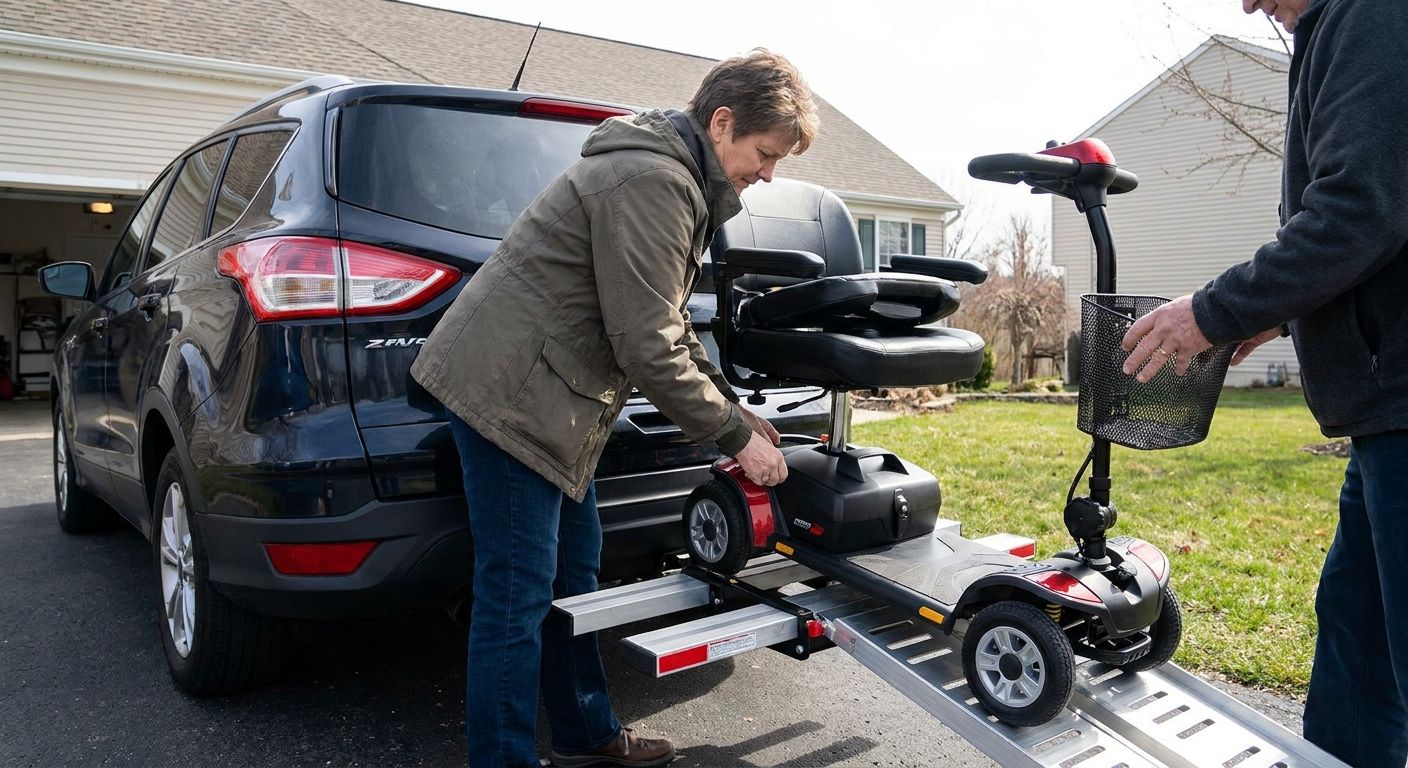
A hitch-mounted transport wheelchair carrier for small cars works for scooters under the carrier's rated weight limit — usually a good fit for travel and mid-size models rather than 300 lb heavy-duty units. Best for: drivers with a hatchback or sedan who don't want to disassemble the scooter into pieces every trip.
| Method | Best scooter class | Best for | Verdict |
|---|---|---|---|
| Trunk, fully disassembled | Travel (40-60 lbs) | Sedans, small SUVs | Buy |
| Hitch-mounted carrier | Travel to mid-size | Frequent day trips | Buy |
| Van ramp or in-floor lift | Mid-size to heavy-duty | Daily users, larger scooters | Buy |
| Improvised loading with no straps | Any | Nobody | Skip |
Transporting a scooter in a van with a ramp or lift
For mid-size and heavy-duty scooters, a fold-out ramp or a powered in-floor lift removes the disassembly step entirely — you drive the scooter straight in and lock the wheels to floor anchors. Best for: daily scooter users and caregivers who load and unload multiple times a day, since disassembly on every trip isn't practical at that frequency.
Transporting a scooter on an airplane
Airlines treat mobility scooters as assistive devices, which usually means they travel free of standard baggage handling and get gate-checked or stowed in the cargo hold. The battery is the part that determines whether you need airline approval: lithium batteries under 300 watt-hours generally don't need special sign-off, per FAA guidance, while larger batteries do. Best for: travelers flying with a folding or travel-class scooter — confirm your model's watt-hour rating with the airline before you book, since this single number decides how much paperwork you'll do at the gate.
Why transport methods vary
The right method for you depends on a handful of factors, not personal preference:
- Scooter weight class — a 45 lb travel scooter and a 300 lb heavy-duty model need completely different equipment.
- Vehicle type — sedans and hatchbacks favor disassembly or a hitch carrier; vans and SUVs can handle a ramp or lift.
- Frequency of transport — daily users benefit from a permanent ramp or lift; occasional travelers can get by with trunk loading.
- Battery type and rating — lithium batteries under 300 Wh simplify air travel; larger batteries add steps.
- Physical ability to lift — a caregiver loading a scooter alone needs a carrier or lift, not a disassemble-and-carry routine.
- Budget for equipment — a hitch carrier or ramp is an added cost most trunk-loading setups avoid.
A scooter that outweighs its carrier's rating is a liability, not a convenience.
“A scooter that outweighs its carrier's rating is a liability, not a convenience.”
Edward Creation stocks mobility scooters across these weight classes, along with the carriers and transport wheelchairs built to move them — matching the scooter to the right hauling setup up front saves a return trip to the store later.
Can I fold a mobility scooter to put it in a trunk?
Most travel-class scooters fold or disassemble into 2-4 pieces specifically so they fit in a trunk, while mid-size and heavy-duty models are built for ramps or lifts instead. Check your model's spec sheet for a "folded dimensions" or "disassembled weight" listing before assuming it will fit your car.
Do I need a special hitch carrier for a mobility scooter?
Yes, if your scooter's disassembled or assembled weight is close to or above a standard cargo carrier's rating, since underrated carriers flex and fail under repeated loading. Choose a transport wheelchair carrier built for caregivers on the go rated above your scooter's actual weight, not just its advertised curb weight.
How do I secure a scooter's battery during transport?
Disconnect the battery before loading, then transport it upright and separate from metal tools or loose hardware that could bridge the terminals. For air travel, batteries under 300 watt-hours travel with fewer restrictions in 2026 than larger packs, which is worth checking before you book a flight.
FAQ
How do you transport a mobility scooter in a car?
Disassemble it into its lightest parts, load the heaviest piece low and centered, and strap it down at four points using cargo straps rated above its disassembled weight. Travel scooters at 40-60 lbs fit most trunks without a carrier.
What is the best way to transport a mobility scooter without lifting it?
A van ramp or in-floor lift lets you drive the scooter in and lock the wheels to floor anchors, skipping disassembly entirely. This works best for mid-size and heavy-duty scooters over 100 lbs.
Can mobility scooters fly on airplanes?
Yes, airlines treat mobility scooters as assistive devices and typically transport them free of standard baggage handling. The battery's watt-hour rating, not the scooter itself, usually determines what paperwork the airline requires.
Is a hitch-mounted carrier safe for a mobility scooter?
Yes, as long as the carrier's weight rating exceeds the scooter's actual weight, including any accessories left attached. An underrated carrier flexes and can fail on rough roads.
How heavy is a mobility scooter for transport purposes?
Travel scooters run 40-60 lbs disassembled, mid-size models run 100-150 lbs, and heavy-duty scooters built for larger users often exceed 250-300 lbs. This weight class is the single biggest factor in choosing a transport method.
Do you need to remove the battery before transporting a scooter?
Disconnecting the battery before loading prevents loose-connection faults and accidental power draws during transit. Store it upright and away from loose metal tools or hardware.
What's the difference between a transport wheelchair carrier and a scooter carrier?
Transport wheelchair carriers are generally rated for lighter loads than scooter carriers, since wheelchairs weigh less than most scooters. Check the weight rating on the carrier against your specific scooter model before buying either.
One last thing
The detail most people miss isn't the straps or the ramp — it's the 10-15 minute recheck. Cargo straps settle once a vehicle is moving, and a scooter that was locked tight in the driveway can have several inches of play by the time you hit the highway on-ramp. Build that one stop into every trip in 2026, and the rest of the transport routine above will hold.