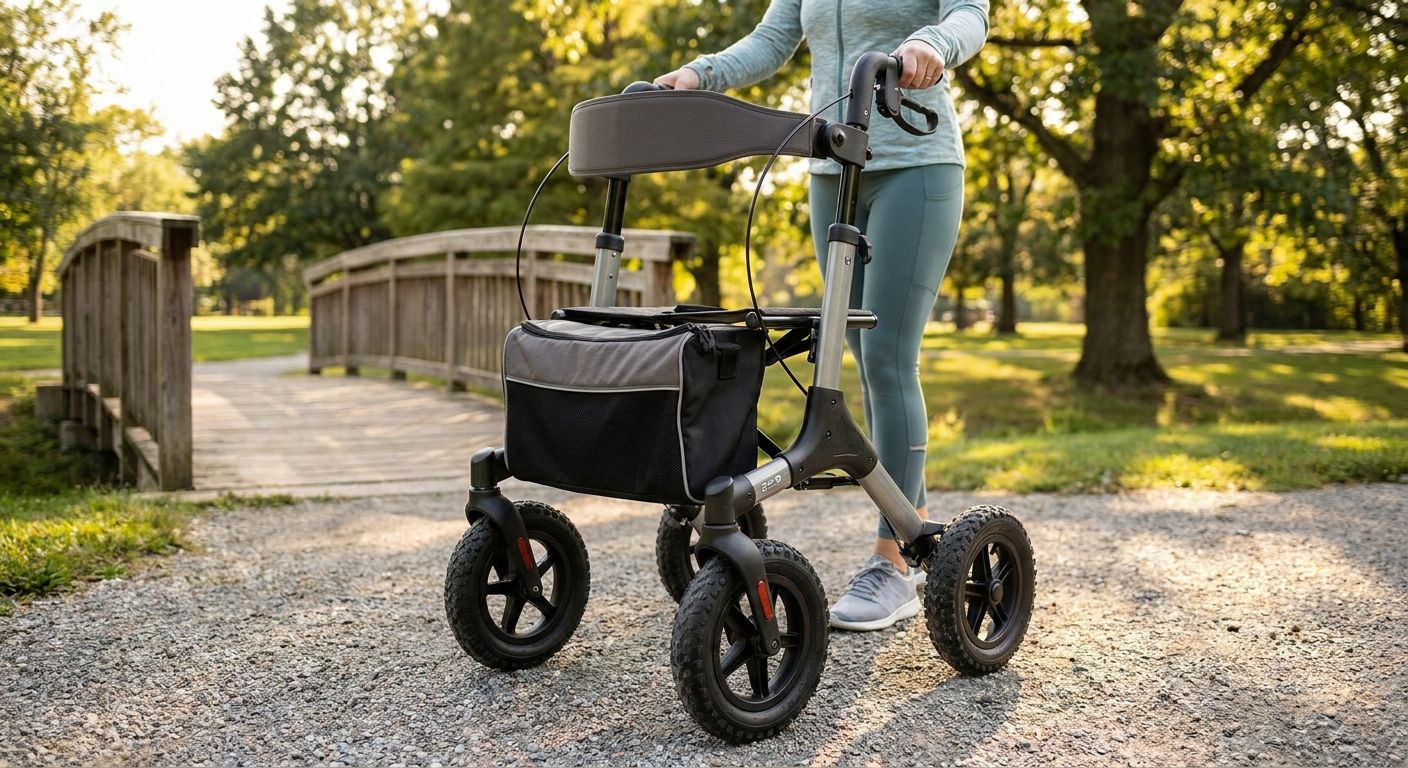
Rollator walker outdoor use comes down to three things: wheel size, brake control, and how much ground you actually need to cover. A rollator built for hallways stalls the moment it hits gravel, a curb cut, or a cracked sidewalk — the wheels that glide across tile catch on anything rougher.
- Rollator walker outdoor models need 8- to 10-inch wheels and locking hand brakes to handle curbs, gravel, and slopes.
- Standard indoor rollators use 6-inch wheels that catch on cracks and tip on uneven pavement.
- Most rollators hold 300 to 400 lbs; bariatric outdoor models go up to 500 lbs.
- Seniors covering more than a few blocks outdoors often outgrow a rollator and need a scooter or transport wheelchair instead.
- Brake cables stretch over time — outdoor users should check tension monthly, not just at purchase.
Why this matters for outdoor mobility support
A rollator that works fine in the kitchen can become a fall risk on a driveway. Outdoor terrain adds three variables indoor use never tests: incline, surface texture, and distance. A senior using a rollator to get from the bedroom to the bathroom needs almost none of the features that matter for a walk around the block or a trip to the mailbox.
The difference shows up fastest at curbs and thresholds. Smaller 6-inch wheels, common on budget indoor rollators, drop into expansion joints and catch on lips as small as half an inch. Larger 8- to 10-inch wheels roll over the same gap without a hitch. For anyone shopping specifically for mobility equipment built for daily outdoor use, wheel size is the first spec to check — not the price tag, not the color.
Choosing and using a rollator walker for outdoor terrain
Check wheel size and tread before buying
Wheel diameter decides whether a rollator handles real outdoor terrain or just looks like it can.
- 6-inch wheels: fine for smooth indoor floors, struggle outside
- 8-inch wheels: handle most sidewalks and light gravel
- 10-inch wheels: better for parks, trails, and rougher pavement
- Pneumatic (air-filled) tires absorb bumps better than solid rubber
- Wider tread reduces slipping on wet or leaf-covered pavement
Test the brake system on a slope
Locking hand brakes are the single most important safety feature on an outdoor rollator, and they degrade with use.
- Squeeze both brakes at a stop and confirm the rollator holds still on a slight incline
- Check that the parking-lock function engages fully, not just partially
- Look for brake cables that feel loose or spongy compared to when new
- Ask a mobility equipment retailer to inspect cable tension once a year
- Replace brake pads at the first sign of reduced stopping power
Match frame width to doorways and terrain
A rollator too wide for a doorway is a daily annoyance; one too narrow for outdoor stability is a fall risk.
- Measure the narrowest doorway or gate the user passes through regularly
- Confirm the folded width fits in the trunk or backseat of the family car
- Wider wheelbases resist tipping on uneven grass or sloped driveways
- Taller users need a longer wheelbase for stability, not just a taller frame
Adjust seat height and handlebar reach
Most rollators double as a portable seat, and outdoor trips are exactly when that matters most.
- Set handlebar height so elbows bend at roughly 15 degrees when standing upright
- Seat height should let feet rest flat on the ground when sitting
- Re-check the adjustment after a coat or heavier shoes change posture in cold weather
- A too-high handlebar forces a hunched stance that reduces balance over uneven ground
Add accessories built for outside use
A rollator meant for outdoor errands needs more than what ships in the box.
- A basket or under-seat pouch for groceries and mail
- A cup holder for hydration on longer outings
- A cane holder if a backup cane is part of the routine
- Reflective strips or a small light for early morning or evening walks
- A rain or sun cover for the seat cushion
Know when to step up to a scooter or transport wheelchair
A rollator is a walking aid, not a substitute for a vehicle. Once outdoor trips stretch past a few blocks, or fatigue sets in before the destination does, a manual rollator starts working against the user instead of for them.
This is where the choice widens. A mobility scooter covers longer outdoor distances without the physical effort of pushing a frame, while a transport wheelchair works better for caregivers pushing rather than the user walking. Neither replaces a rollator for short indoor-to-outdoor transitions — they solve a different problem: distance and endurance.
A rollator walker outdoor setup only works if the wheels, brakes, and frame match the terrain the user actually covers — a hallway rollator on a gravel path is a fall waiting to happen.
Rollator walker outdoor options compared
| Option | Best for | Key limitation |
|---|---|---|
| Indoor rollator (6-inch wheels) | Hallways, apartments, short indoor-to-porch trips | Wheels catch on cracks, curbs, and gravel |
| Outdoor/all-terrain rollator (8- to 10-inch wheels) | Sidewalks, parks, errands within a few blocks | Still manual — no help over long distances or hills |
| Mobility scooter | Extended outdoor trips, larger parks, longer errands | Needs a vehicle or transport method for storage |
| Transport wheelchair | Caregiver-pushed outings, appointments, travel | Requires someone else to push; not for independent walking |
Verdict: an outdoor/all-terrain rollator with 8- to 10-inch wheels is the right buy for anyone still walking independently outside; a mobility scooter or transport wheelchair is the right move once distance or fatigue becomes the limiting factor.
Common mistakes with outdoor rollator use
- Buying an indoor rollator for outdoor errands. The 6-inch wheels that work fine on tile catch on every crack and curb outside — check the wheel spec before checkout, not after the first fall risk.
- Ignoring brake cable stretch. Cables loosen with regular outdoor use, and a rollator that used to lock firmly on a slope may not anymore — test brakes monthly, not just at purchase.
- Skipping a turning radius test. Store aisles, curb cuts, and elevator doors are tighter than open sidewalks; a rollator that feels fine outdoors can be unmanageable indoors at the destination.
- Not adding a basket or bag. Outdoor trips almost always involve carrying something back — mail, groceries, a small purchase — and a rollator without storage turns into a two-handed problem.
- Pushing past the rollator's realistic range. Continuing to use a manual rollator for trips that leave the user exhausted or unsteady, instead of stepping up to a scooter or transport wheelchair, is where outdoor falls happen most.
FAQ
What's the best wheel size for a rollator walker outdoor?
8- to 10-inch wheels handle outdoor terrain best in 2026 — they roll over cracks, curbs, and light gravel that 6-inch indoor wheels catch on. Pneumatic tires add extra shock absorption on rougher sidewalks.
Is a rollator better than a mobility scooter for outdoor use?
A rollator is better for short outdoor trips where the user is still walking independently; a mobility scooter is better once distance or fatigue becomes the limiting factor. Most seniors start with a rollator and add a scooter for longer outings.
How much weight can an outdoor rollator hold?
Most standard rollators hold 300 to 400 lbs, while bariatric outdoor models are rated up to 500 lbs. Always check the weight capacity listed on the specific model before buying.
Can a rollator walker be used on grass or gravel?
An all-terrain rollator with 8- to 10-inch wheels and pneumatic tires handles grass and light gravel reasonably well in 2026. A standard 6-inch-wheel indoor rollator struggles on both surfaces and increases fall risk.
How often should rollator brakes be checked?
Brake cables should be checked monthly for outdoor users, since regular use stretches the cable and reduces stopping power over time. A rollator that locked firmly a year ago may need a brake adjustment now.
What's the difference between a rollator and a transport wheelchair?
A rollator is walked by the user and provides support while standing; a transport wheelchair is pushed by a caregiver and the user sits the entire time. They solve different mobility needs and are not interchangeable.
Do rollators fold for car transport?
Most rollators fold flat for storage in a trunk or backseat, but folded width and weight vary by model. Confirm the folded dimensions fit the specific vehicle before buying, especially for smaller cars.
When should someone switch from a rollator to a mobility scooter?
Switch when outdoor trips regularly leave the user fatigued before reaching the destination, or when distances exceed a few blocks. A mobility scooter removes the physical effort of pushing a frame over longer outdoor routes.
One last thing
The wheel spec sheet matters more than the brand name on an outdoor rollator. Two rollators can look identical in a store photo, but one with 6-inch wheels and one with 10-inch wheels perform completely differently the first time they hit a cracked sidewalk or a gravel path — check that number before anything else in 2026.