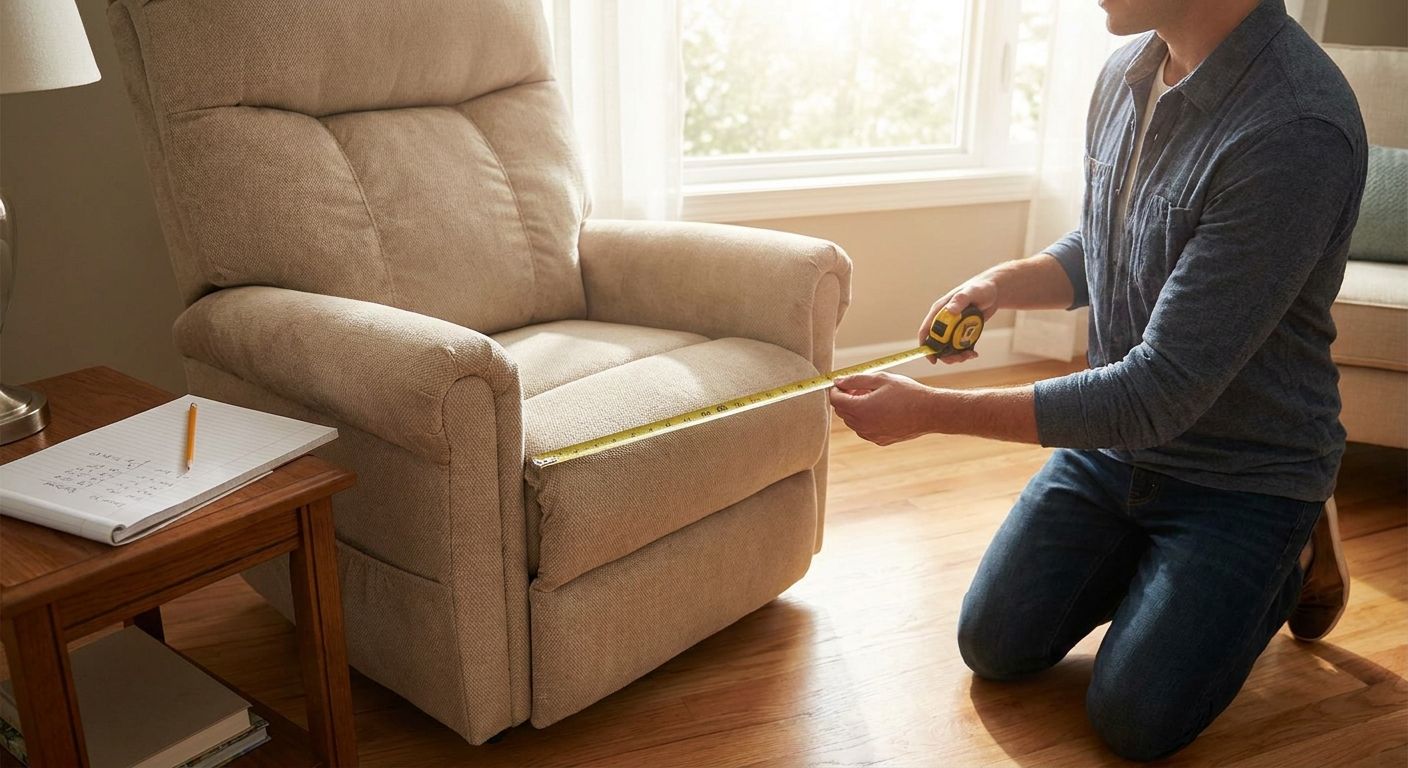
Measuring your space for a lift chair recliner comes down to five numbers: doorway width, hallway clearance, wall clearance behind the chair, full recline floor depth, and the walking path from your entry to the room. Miss the full recline depth and you'll end up with a chair that arrives fine but can't open all the way once it's against the wall.
- Measuring space for a lift chair means checking five numbers: door width, hallway clearance, wall clearance, recline depth, and floor path.
- Full recline depth is the measurement most buyers skip, and it's the one that stops a chair from opening all the way in 2026.
- Wall-hugger designs like the Nimbus Zero-Gravity Power Recliner need far less rear clearance than a standard reclining lift chair.
- Big and tall lift chairs such as the GrandNest and Titan need extra width and floor depth on top of the standard checklist.
Why this matters
A lift chair recliner ships as one solid piece in most cases, not flat-packed furniture you can carry through a doorway sideways. If the chair doesn't clear your narrowest doorway or hallway, it doesn't matter how comfortable the seat is once it's inside the room — it never gets there.
The second failure point shows up after delivery. A chair that fits through the door but sits too close to the wall can't extend into a full recline, which defeats the point of buying a wall-hugger recliner or standard lift chair in the first place. Measuring correctly in 2026 takes ten minutes with a tape measure and saves a return shipment.
How do you measure a room for a lift chair recliner?
Follow these steps in order, and write down every number before you shop:
- Measure your narrowest doorway width — including the door frame, not just the open gap, at the point the chair box will pass through.
- Measure hallway width at its tightest point, especially where the hallway turns a corner into the room.
- Measure the wall space where the chair will sit, side to side, adding a few inches on each side for armrest clearance and side tables.
- Measure from the wall to the nearest obstacle in front of the chair — a coffee table, another chair, or a doorway — since this becomes your full recline depth.
- Check the ceiling height and any overhead fixtures if the chair will sit under a sloped ceiling or hanging light.
- Measure your own seat height comfort by sitting in a dining chair and noting whether your feet sit flat on the floor.
- Confirm the floor path from your front door to the final room is clear of rugs, thresholds, or narrow turns that could stop delivery.
Write these seven numbers on your phone before browsing chairs — most product pages list seat width, closed depth, and fully reclined depth, and you're matching your numbers against theirs.
“If the tape measure stops short of 36 inches at the narrowest hallway point, no lift chair in a closed box makes it to the room.”
Wall-hugger lift chairs: the smallest footprint option
A wall-hugger lift chair reclines by sliding the seat forward as the back drops, instead of swinging the whole chair backward into open floor space. That design cuts down significantly on the rear clearance a standard recliner needs, which makes it the better fit for apartments, studio bedrooms, or rooms where the chair sits close to a wall. The trade-off is a slightly more limited recline angle compared to chairs built for open floor placement. Best for: small rooms and apartments where wall space is fixed. Buy.
Standard reclining lift chairs: plan for full recline depth
A standard lift chair swings the backrest and footrest outward as it opens, which means the chair needs open floor space behind and in front of it, not just beside it. This is the design most shoppers picture when they think "lift chair," and it usually delivers a deeper, flatter recline than a wall-hugger model. It only works if the room has the floor depth to match — measure from the back of the chair's final position to the nearest wall or furniture piece. Best for: living rooms with open floor space behind the chair. Buy if your depth measurement clears the spec sheet.
Big and tall lift chairs: add width and floor space
Oversized lift chairs built for larger frames, like the oversized lift chairs for big and tall users category, run wider in the seat and heavier in the frame than standard models. That extra width needs to come out of your total wall measurement, and the added frame depth often pushes the fully reclined footprint several inches past a standard-size chair. Measure the full width of your intended wall space twice — once for the chair itself, once with armrests and any side table you plan to keep nearby. Best for: larger frames needing wider seats and higher weight capacity. Buy after confirming both width and depth.
Why lift chair space requirements vary
Space needs shift from one lift chair to the next for a handful of reasons:
- Recline mechanism — wall-hugger designs need less rear clearance than chairs that swing backward.
- Seat width and frame size — big and tall models add inches on both sides of a standard measurement.
- Footrest extension — some chairs extend the footrest further than others at full recline, changing total floor depth.
- Weight capacity and frame construction — heavier-duty frames built for higher capacity, covered in the guide on choosing the right lift chair weight capacity, tend to run larger overall.
- Room layout — corner placement, sloped ceilings, and nearby furniture all shrink the usable footprint even when the wall itself is wide enough.
- Delivery path — a chair that fits the room can still fail if the doorway or hallway leading to it is too narrow.


How much wall clearance does a lift chair recliner need?
Wall clearance depends on the recline mechanism: wall-hugger lift chairs need only a few inches between the chair back and the wall, while standard reclining lift chairs need open floor space behind them to swing the backrest out. Check the product's fully reclined depth measurement and compare it against your own wall-to-obstacle measurement before ordering in 2026.
Do lift chairs fit through a standard doorway?
Most lift chairs fit through a standard interior doorway, which typically runs 28 to 36 inches wide in US homes, but oversized or big and tall models can come close to that limit. Measure your narrowest doorway and hallway turn before ordering, since delivery crews can't force a boxed chair through a gap that's too tight.
What if my room is too small for a full-size lift chair recliner?
A small room usually points toward a wall-hugger lift chair or a petite frame model rather than a standard reclining chair. Wall-hugger designs cut down the rear clearance needed for a full recline, and petite frame chairs reduce the total width taken up against the wall, both better matches for compact rooms.
FAQ
How do I measure my room for a lift chair recliner?
Measure doorway width, hallway clearance, wall space, and the floor depth needed for a full recline before ordering. Write all four numbers down and compare them against the chair's spec sheet.
What's the minimum wall clearance for a lift chair?
Wall-hugger lift chairs need only a few inches of rear clearance, while standard reclining lift chairs need open floor space behind them. Check the product's fully reclined depth for the exact figure.
Do I need to measure my doorway for a lift chair delivery?
Yes, measure your narrowest doorway and any hallway turn leading to the room. Standard US interior doors run 28 to 36 inches wide, and a boxed lift chair needs to clear that gap.
Is a wall-hugger lift chair better for small rooms?
A wall-hugger lift chair is generally the better fit for small rooms because it needs less rear clearance than a standard reclining design. It sacrifices a small amount of recline angle in exchange for that footprint.
How much floor space does a big and tall lift chair need?
Big and tall lift chairs need extra width and floor depth beyond a standard-size chair because of their wider seats and extended footrests. Measure both dimensions twice before ordering.
What happens if a lift chair doesn't fit through the door?
A lift chair that doesn't clear the doorway or hallway can't be delivered to the room, regardless of how much floor space the room itself has. Measure the delivery path before measuring the room.
Should I measure my own seat height comfort too?
Yes, sit in a dining chair and check whether your feet sit flat on the floor to estimate your ideal lift chair seat height. This matters as much as room measurements for day-to-day comfort.
One last thing
The measurement buyers skip most often isn't the wall or the doorway — it's the ceiling. A lift chair pushes the user upward during the standing assist cycle, and a low-hanging light fixture or sloped ceiling section can catch a taller user mid-lift long after the chair itself has been measured and approved for the room.