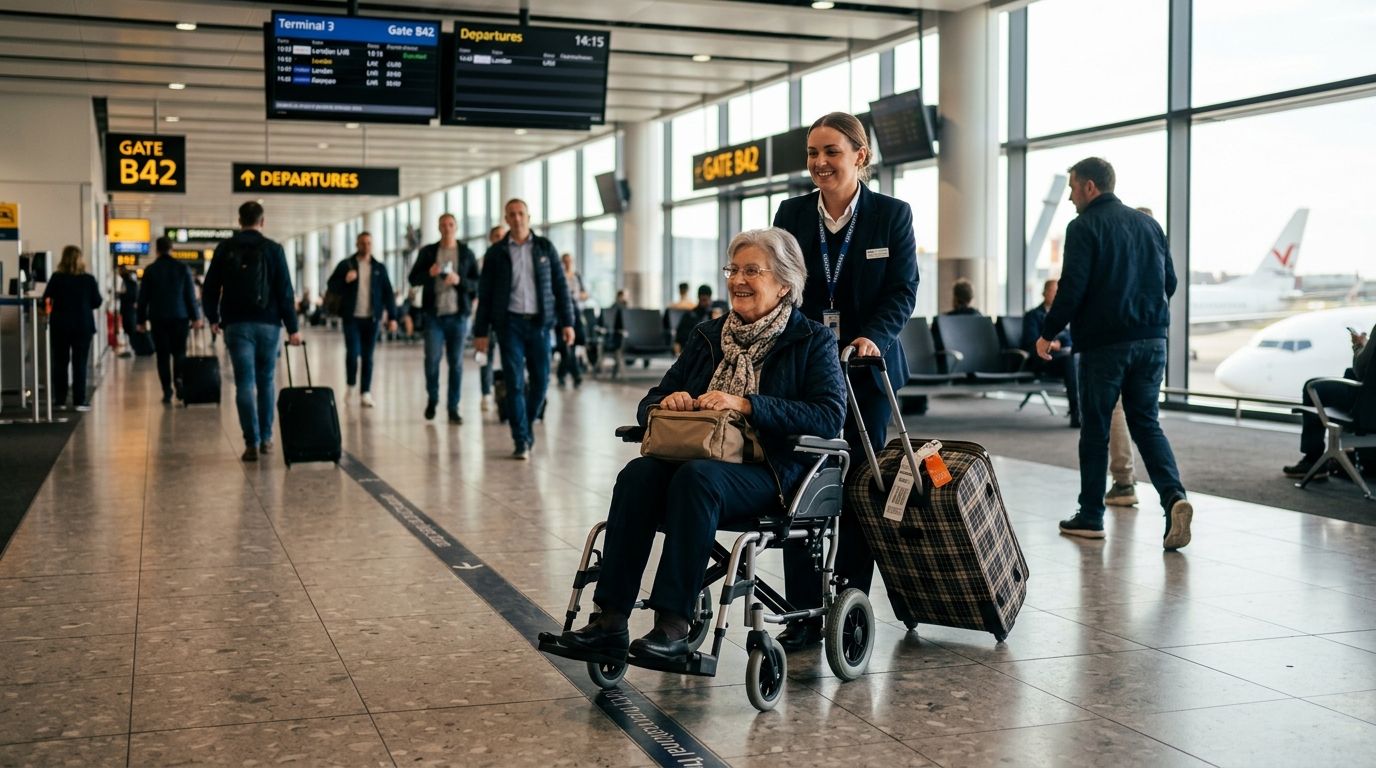
A transport wheelchair for air travel is a lightweight, foldable chair built to move through airport terminals, security lines, and jet bridges without needing to be pushed by the user themselves, and it exists to get someone with limited mobility from curb to gate without a scooter's bulk or a full-size wheelchair's turning radius. Air travelers face a narrower set of constraints than everyday users: overhead bin rules do not apply, but boarding gate width, jet bridge ramps, and TSA screening lanes do.
- A transport wheelchair for air travel should fold flat, weigh under 30 lbs, and have no battery to avoid FAA lithium restrictions.
- Airlines are required under the Air Carrier Access Act to check a wheelchair free, outside standard baggage limits.
- Gate-check is the standard method for transport wheelchairs; TSA allows the chair through security screening with the passenger.
- Caregivers flying solo with a family member need a chair one adult can fold and lift alone in under a minute.
- Manual transport wheelchairs beat power scooters for air travel because there's no battery paperwork or airline pre-approval step.
Why transport wheelchairs matter for air travel
Airports are the one environment where a manual wheelchair beats every other mobility device on the market. Scooters and power chairs run on batteries, and airlines regulated under the Air Carrier Access Act (ACAA) require documentation or pre-approval for lithium batteries above certain thresholds before they'll load the device. A folding transport wheelchair with no motor skips that conversation entirely — it goes to the gate, folds, rides in the cargo hold, and comes back out at the jet bridge on arrival.
The other reason this segment behaves differently: most people buying a transport wheelchair for air travel aren't buying it as a daily-use chair. They're buying it for one trip, one parent, one caregiver pushing from behind. That changes what "good" looks like — fold speed and one-person handling matter more than seat width or cushioning depth.
Prepare the chair before you book
Do this before the flight is even on the calendar, not the night before.
- Confirm the chair folds without tools — armrests or footrests that need a wrench are a liability at a jet bridge
- Weigh the folded chair yourself; airlines want a number if asked, and "about 20 pounds" isn't good enough at the counter
- Check the frame for a battery or motor — if there is one, call the airline's disability services line at least 48 hours out
- Measure the folded footprint against your car trunk or rideshare trunk, since the chair travels with you before it ever reaches the airport
Call the airline's disability desk, not the general line
Every major U.S. carrier has a dedicated accessibility or special assistance line, and it is a different number from general reservations.
- Ask specifically whether the chair gate-checks or counter-checks — policy varies by carrier and by aircraft type
- Request wheelchair assistance codes (WCHR, WCHC, WCHS) be attached to the reservation, not just noted in a comment field
- Confirm whether an escort chair is provided at the gate if your own chair goes to cargo before boarding
- Get a name and confirmation number for the call — verbal assurances at the counter carry more weight when backed by a reference number
Pack the chair for cargo handling
Baggage handlers are not gentle, and transport wheelchairs are not built like luggage.
- Remove and hand-carry any detachable cushion or bag — cargo holds are not climate-controlled the way the cabin is
- Tag the chair with your name, flight number, and a destination phone number, separate from any airline-issued tag
- Fold and lock the frame per the manufacturer's instructions so it doesn't spring open mid-transit
- Photograph the chair before it's checked, in case damage claims come up on arrival
Get through security with the chair
TSA has a standing process for wheelchairs, and knowing it in advance saves time at the checkpoint.
- Tell the TSA officer you have a wheelchair before you reach the scanner, not after
- Expect a pat-down or explosive trace swab on the chair itself — this is routine, not a flag on the passenger
- A companion can usually walk the passenger to the gate even without a boarding pass, through the TSA Cares program — call 72 hours ahead for that accommodation
- Keep the folding chair as your gate escort until wheelchair assistance staff take over at boarding
Decide who folds and lifts the chair
This is the step people skip and regret at the gate.
- If one caregiver is traveling alone with the passenger, test a solo fold-and-carry at home before the trip — not at a jet bridge with a boarding line behind you
- Choose a chair rated for one-person folding if there's no second adult traveling
- Practice the unfold-and-lock sequence at least twice before departure day
- If the chair is genuinely too heavy for one person, request gate-side wheelchair assistance instead of self-managing the fold
Plan for the arrival airport, not just departure
The return leg and connecting airports get less planning than the outbound flight, and that's where trips go wrong.
- Confirm wheelchair assistance is booked for every leg, not just the first flight
- Build 20-30 extra minutes into layovers when a chair has to be walked or transported between gates
- Check whether the arrival airport gate-delivers checked wheelchairs immediately at the jet bridge or requires a baggage claim pickup
- Keep a spare set of chair parts (a pin, a strap) in a carry-on in case something loosens in transit
For drivers handling the chair before and after the flight, the fold-and-load routine mirrors what's covered in how to transport a mobility scooter safely — the airport isn't the only place a folded mobility device needs to survive rough handling.
Transport wheelchair options for air travel
| Option | Best for | Key limitation |
|---|---|---|
| Manual folding transport wheelchair | Solo caregivers, no battery paperwork | Requires someone to push |
| Power wheelchair/scooter | Passengers who self-propel at destination | Battery pre-approval and longer airline lead time |
| Airport-provided wheelchair (loaner) | One-way trips with no personal chair needed | Not available for continued use after the terminal |
| Rental transport chair at destination | Travelers who don't want to check a chair | Availability varies by city and airport |
Any reader comparing a personal chair against a scooter for the same trip should read mobility scooters for air travel before booking — the battery rules alone change what's realistic for a same-week trip in 2026.
Verdict: a manual folding transport wheelchair is the right call for air travel in 2026 for anyone who doesn't need to self-propel at the destination — it skips battery paperwork, folds into cargo without airline pre-approval, and costs less to check than a power chair.
Common mistakes air travelers make with transport wheelchairs
- Booking the flight before calling the disability desk — special assistance codes get attached faster when they're on the reservation from day one, not added the week of travel
- Assuming the chair counts as checked baggage — it doesn't, and travelers who don't clarify this in advance sometimes get charged in error at the counter
- Skipping the solo-fold practice run — a caregiver discovering at the gate that they can't fold the chair alone delays boarding for the whole row
- Not tagging the chair with contact info — airline tags get lost in cargo handling more often than passengers expect
- Ignoring layover time — a 40-minute connection is tight even without wheelchair transfer; with it, it's a missed flight risk
Caregivers managing this process for a parent or spouse should also look at transport wheelchairs for caregivers on the go — the folding and lifting routine for air travel is close to what's needed for daily errands, just under more time pressure.
FAQ
Can I bring a transport wheelchair on a plane for free?
Yes. Under the Air Carrier Access Act, U.S. airlines must check a wheelchair at no charge and outside the standard baggage allowance in 2026.
Do transport wheelchairs need battery approval for flights?
Manual transport wheelchairs have no battery, so they skip the lithium battery approval process required for power wheelchairs and scooters.
Is a transport wheelchair better than a mobility scooter for air travel?
For most air travelers, yes — a manual transport wheelchair folds smaller, has no battery paperwork, and checks faster at the gate than a scooter.
Can someone accompany a wheelchair passenger through airport security without a ticket?
Often yes, through TSA's Cares program, which allows a companion to escort a passenger to the gate. Call at least 72 hours before the flight to arrange it.
Does the airline provide a wheelchair at the gate if mine goes to cargo?
Most carriers provide an escort chair when a personal wheelchair is checked before boarding, but confirm this directly with the airline's disability services line.
How much does a transport wheelchair for air travel cost?
Pricing varies by frame material, weight capacity, and features, so check current listings on the retailer's site rather than relying on a fixed figure.
What happens if a transport wheelchair is damaged during a flight?
Airlines are liable for damage to mobility devices under the ACAA, so photograph the chair before check-in and file a report at the airport before leaving if damage is found.
One last thing
The detail most travelers miss: a folding transport wheelchair with zero battery components clears airline pre-approval steps that a power scooter simply can't skip, which is the single biggest reason manual chairs remain the default recommendation for one-off air travel in 2026, even for people who use a power chair every other day at home.