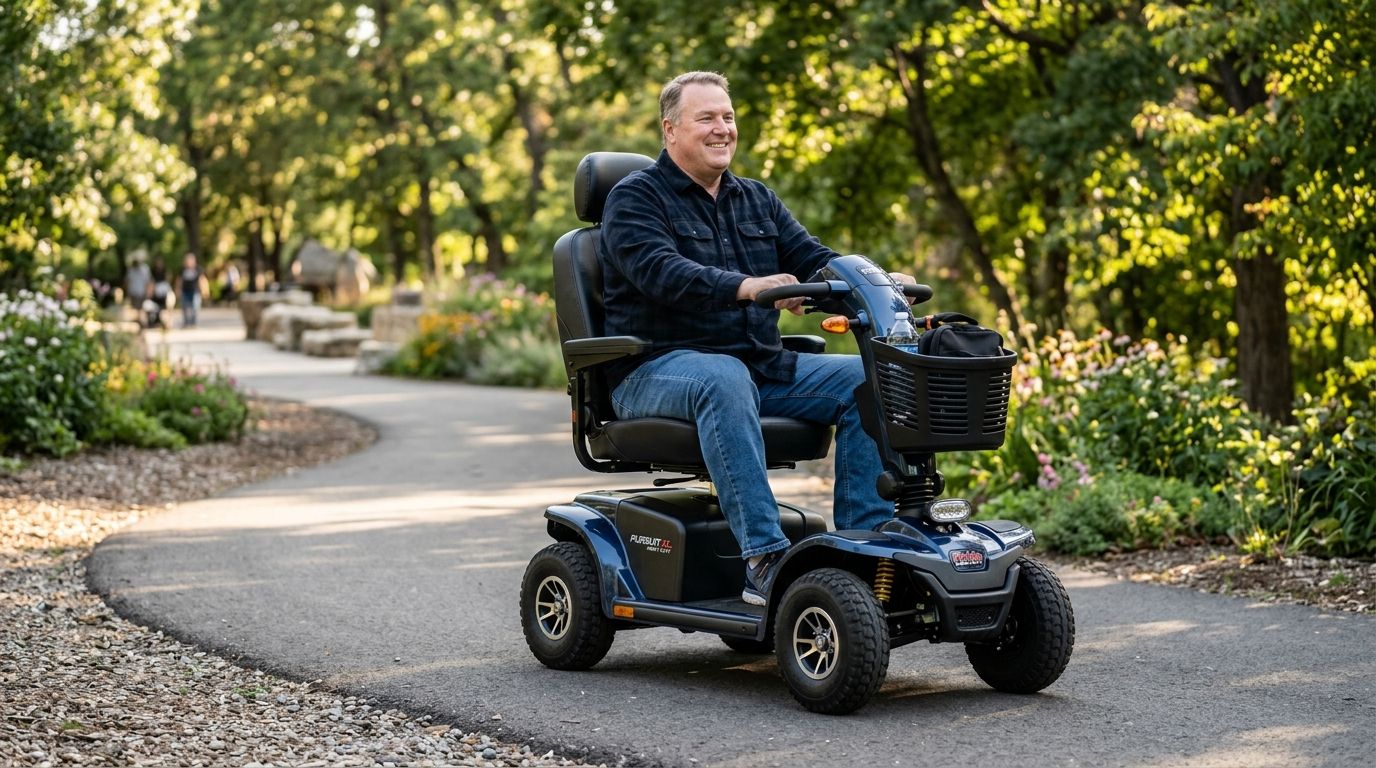
Big and tall riders need scooters built for higher weight capacity, wider seats, and more ground clearance than a standard model offers — and the right choice depends entirely on where you'll actually use it.
- The best heavy duty mobility scooter for big and tall riders depends on use case, not just weight rating.
- Heavy-duty 4-wheel scooters win on stability for riders near or above 400 lbs.
- Bariatric 3-wheel models turn tighter in apartments and hallways than 4-wheel units.
- Portable heavy-duty scooters trade top weight capacity for trunk-friendly folding or disassembly.
- All-terrain heavy-duty scooters handle gravel and grass but weigh the most to transport.
Why this matters
Most "best mobility scooter" lists are written for a 250 lb rider on flat sidewalks. That's not you, and it's not the reader searching for the best heavy duty mobility scooter for big and tall in 2026. A scooter rated for 250-300 lbs will strain its motor, drain its battery faster, and wear out its suspension early if you're closer to 400-500 lbs.
Edward Creation stocks mobility equipment built around real-world capacity needs, not marketing minimums, and the Edward Creation catalog is a reasonable starting point once you know which type fits your daily routine. The five scooter types below cover the actual decisions big and tall riders face in 2026 — stability versus turning radius, portability versus payload, and indoor versus outdoor use.
What makes the best heavy duty mobility scooter
- Weight capacity with margin. A scooter rated exactly at your body weight will underperform; look for at least 50-75 lbs of headroom above your actual weight.
- Seat width and depth. Big and tall riders need 20 inches or more of seat width, not the 18-inch standard seat found on entry-level scooters.
- Ground clearance. Higher clearance matters more once total load (rider plus bags or a wheelchair-cushion) climbs past 350 lbs.
- Turning radius. A wide, stable base helps with stability but hurts maneuverability indoors — this is the core tradeoff across every option below.
- Portability for transport. Heavier frames rated for bigger riders are usually harder to lift, fold, or fit in a trunk without a ramp or lift.
- Battery range under load. Heavier riders draw more from the battery per mile than the manufacturer's advertised range assumes.
At a glance: heavy-duty scooter types compared
| Type | Best for | Standout feature | Key limitation |
|---|---|---|---|
| Heavy-duty 4-wheel scooter | Maximum stability at higher weight | Wide stable base, higher weight capacity | Wider turning radius, harder in tight spaces |
| Bariatric 3-wheel scooter | Tight turns in apartments and hallways | Tighter turning radius | Less stable on uneven or outdoor ground |
| Portable heavy-duty travel scooter | Air travel and car trunk transport | Foldable or disassembles into parts | Lower weight capacity than full-size units |
| All-terrain heavy-duty scooter | Outdoor adventures on grass or gravel | Larger tires, more ground clearance | Heaviest to lift or load, hardest to store |
| Heavy-duty errand scooter | Daily grocery runs and short trips | Front and rear storage baskets | Not built for long-distance or rough terrain |
1. Heavy-duty 4-wheel scooter: best for maximum stability
A 4-wheel heavy-duty scooter puts weight on a wider base, which is exactly what a bigger rider needs when getting on and off, going up a ramp, or crossing an uneven curb cut. These units typically carry weight capacities in the 400-600 lb range, well above the 250-300 lb rating on standard scooters.
Heavy-duty 4-wheel scooter pros:
- Highest stability of any scooter type on this list
- Weight capacity headroom for riders in the upper end of big-and-tall sizing
- Wider seat options, usually 20-24 inches
- Smoother ride over cracks, transitions, and small bumps
Heavy-duty 4-wheel scooter cons:
- Wider turning radius makes indoor use in small apartments harder
- Heavier overall frame, harder for a caregiver to load alone
- Takes up more storage space than a 3-wheel model
Best for: Riders who prioritize stability over indoor maneuverability. Verdict: Buy if your main use is outdoor sidewalks, driveways, and errands rather than tight indoor hallways.
2. Bariatric 3-wheel scooter: best for tight turns in small spaces
The tighter front-wheel design on a 3-wheel bariatric scooter turns in a smaller radius than any 4-wheel heavy-duty unit, which matters a lot in an apartment, a small kitchen, or a hallway lined with furniture.
Bariatric 3-wheel scooter pros:
- Smallest turning radius of the heavy-duty options
- Easier to navigate around furniture and doorways
- Still rated for higher weight capacities than standard 3-wheel scooters
Bariatric 3-wheel scooter cons:
- Less stable than a 4-wheel base on uneven outdoor terrain
- Can feel tippy at higher speeds on a slope
- Generally a narrower seat than the widest 4-wheel models
Riders living in a compact unit should also check what fits the room itself — the guide on mobility scooters for small apartments and easy storage covers turning radius against real hallway widths.
Best for: Indoor-first users in apartments or condos. Verdict: Buy if most of your scooter time happens inside your home rather than outdoors.
3. Portable heavy-duty travel scooter: best for air travel and trunk transport
A portable heavy-duty scooter folds down or breaks into liftable pieces, which matters if you're loading it into a sedan trunk or checking it at an airport gate. The tradeoff is a lower weight capacity ceiling than a full-size 4-wheel unit — most portable heavy-duty models top out lower than the largest stationary frames.
Portable heavy-duty travel scooter pros:
- Breaks down for car trunk or airline transport
- Lighter individual pieces, easier for one person to lift
- Still rated above standard travel scooters for bigger riders
Portable heavy-duty travel scooter cons:
- Lower maximum weight capacity than a full-size heavy-duty scooter
- Smaller seat and shorter frame than non-portable options
- Battery range is usually shorter due to a smaller pack
Before booking a flight or a long drive, check how to transport a mobility scooter safely for load and disassembly steps that apply to bigger frames.
Best for: Riders who travel often and need a scooter that fits in a trunk without a ramp. Verdict: Buy if portability outranks top weight capacity for your situation.
4. All-terrain heavy-duty scooter: best for outdoor adventures
Larger tires and more ground clearance let an all-terrain heavy-duty scooter handle gravel driveways, grass, and uneven yards that would stall a standard 4-wheel unit. This is the heaviest category on the list, and that weight works against you the moment you need to load it.
All-terrain heavy-duty scooter pros:
- Highest ground clearance of any option here
- Larger, more aggressive tires handle grass and gravel
- Stable at speed on outdoor paths
All-terrain heavy-duty scooter cons:
- Heaviest to lift, load, or store of any type on this list
- Overkill for indoor-only or grocery-run use
- Usually the largest overall footprint
For riders who want the outdoors without staying strictly on pavement, mobility scooters for outdoor adventures breaks down terrain-specific features in more detail.
Best for: Riders who spend real time on lawns, trails, or unpaved paths. Verdict: Buy if pavement-only scooters have left you stuck at the edge of the yard.
5. Heavy-duty errand scooter: best for grocery runs and short trips
This category isn't about raw weight capacity — it's about front and rear basket space, a manageable turning radius in store aisles, and a battery that comfortably covers a round trip to the store and back. It's the most underrated pick on this list because it's built around what a rider actually does most days.
Heavy-duty errand scooter pros:
- Storage baskets sized for grocery bags
- Turning radius tight enough for store aisles
- Battery range matched to short, frequent trips rather than long-distance touring
Heavy-duty errand scooter cons:
- Not designed for rough outdoor terrain
- Smaller battery than long-range or all-terrain models
- Lower ground clearance than an all-terrain unit
Best for: Riders whose scooter use is mostly local errands. Verdict: Buy if grocery runs and short outings are your primary use case, and skip the all-terrain upgrade you don't need.
How we ranked these
Each type above is ranked against the six criteria listed earlier — weight capacity margin, seat width, ground clearance, turning radius, portability, and battery range under real load. No single type wins on all six; that's the point of a decision tree instead of a single leaderboard. The right pick is the one that matches your actual daily terrain and storage situation, not the highest weight rating on the spec sheet.
Which heavy-duty mobility scooter should you choose?
If you split your time between indoor apartment use and short outdoor errands, start with a bariatric 3-wheel scooter for the turning radius, then reconsider a 4-wheel unit if stability becomes a concern. If most of your time is outdoors on driveways and sidewalks, the heavy-duty 4-wheel scooter is the safer default for 2026. Frequent travelers should weigh a portable heavy-duty model against the weight capacity tradeoff before buying, and anyone spending real time on grass or gravel should not settle for a pavement-only frame.
“A heavy-duty scooter rated exactly at your body weight is already underperforming before you sit down.”
FAQ
What is considered a heavy-duty mobility scooter?
A heavy-duty mobility scooter typically carries a weight capacity of 400 lbs or more, compared to 250-300 lbs on standard models. It usually pairs that capacity with a wider seat and a reinforced frame built for bigger riders.
How much weight can a heavy-duty mobility scooter hold?
Most heavy-duty and bariatric scooters fall in the 400-600 lb range as of 2026. Always leave 50-75 lbs of margin above your actual weight rather than buying at the exact limit.
What's the difference between 3-wheel and 4-wheel heavy-duty scooters?
A 3-wheel design turns in a tighter radius, which helps indoors, while a 4-wheel design offers a wider, more stable base for outdoor terrain and higher weight capacity. Pick based on whether you use the scooter more indoors or outdoors.
Can a heavy-duty scooter fit in a car trunk?
Only portable heavy-duty travel scooters that fold or disassemble into pieces reliably fit in a standard trunk. Full-size heavy-duty and all-terrain scooters generally need a ramp or a scooter lift instead.
Are heavy-duty scooters good for outdoor terrain?
Heavy-duty 4-wheel and all-terrain scooters handle uneven sidewalks, gravel, and grass better than portable or errand-focused models. The tradeoff is a heavier frame that's harder to lift or store.
How wide is the seat on a big and tall mobility scooter?
Big and tall mobility scooter seats typically run 20 to 24 inches wide, compared to roughly 18 inches on standard scooters. Wider seats usually come on 4-wheel heavy-duty and bariatric models rather than portable travel units.
Is a heavy-duty scooter allowed on an airplane?
Airlines generally require the scooter to be foldable or disassemble into liftable pieces, which limits air travel to portable heavy-duty models rather than full-size 4-wheel units. Check with the airline directly before booking, since battery type and size rules vary.
How do I choose the right heavy-duty scooter for grocery shopping?
Prioritize a tight turning radius for store aisles and front or rear basket space over maximum weight capacity or all-terrain tires. A heavy-duty errand scooter is built specifically for this use case rather than long-distance or off-road riding.
One last thing
The single biggest mistake big and tall riders make in 2026 isn't picking the wrong type — it's buying at the exact weight limit instead of below it. A scooter rated for 450 lbs carrying a 445 lb rider plus a bag of groceries is already over its comfortable working range, and that shows up first in battery drain and motor strain, not in a dramatic failure. Buy above your number, not at it.