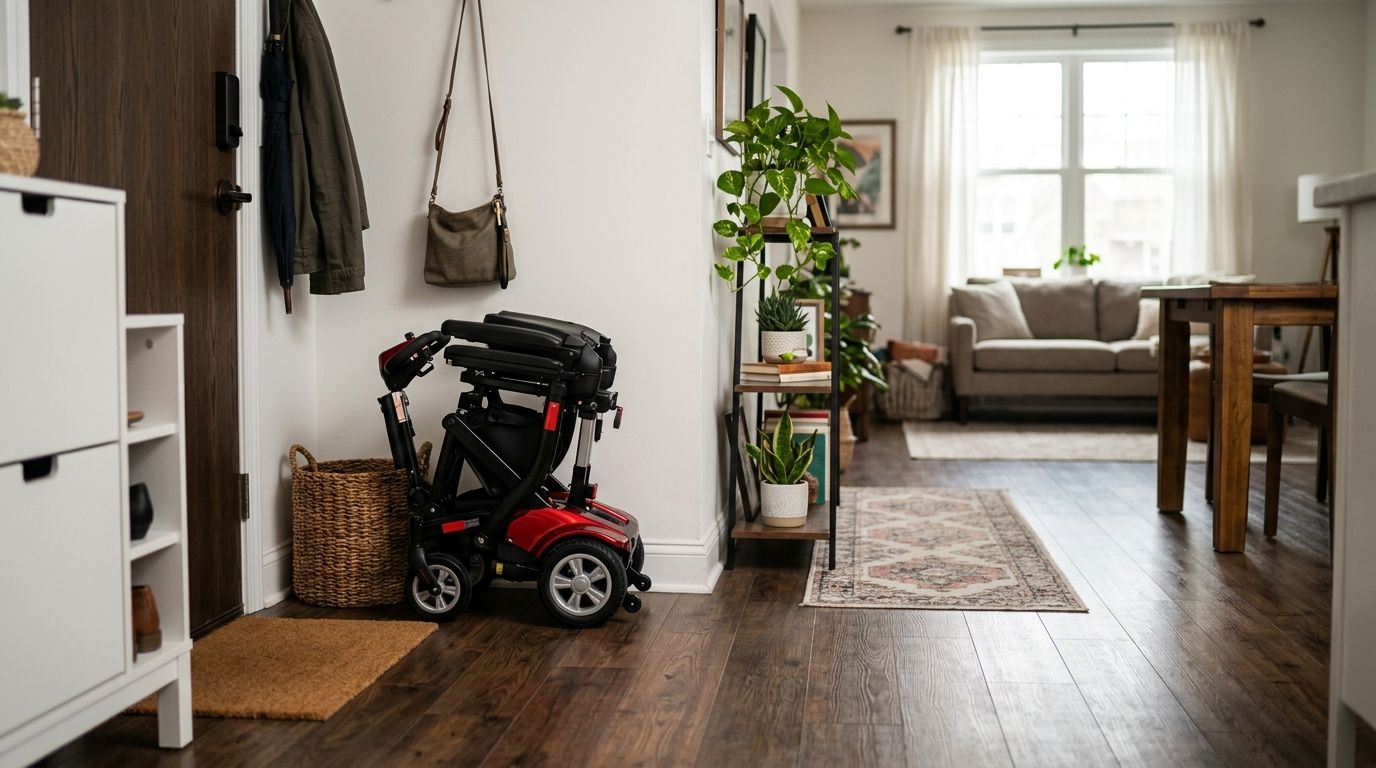
A mobility scooter for small apartment living is a compact, foldable, or three-wheel model sized to clear narrow hallways, tight doorway turns, and closet-level storage without becoming a daily obstacle. What makes this segment different from a general scooter buyer is the math of square footage: apartment hallways run narrower than single-family homes, elevators cap what fits through the door, and there's rarely a garage to hide a full-size four-wheel base.
- A mobility scooter for small apartment use should fold or disassemble into pieces under 40 lbs for closet storage in 2026.
- Three-wheel scooters turn tighter than four-wheel models, which matters most in galley kitchens and narrow hallways.
- ADA guidelines call for a 60-inch turning diameter in accessible spaces, a useful benchmark for your own hallway width.
- Standard US interior doorways clear about 32 inches, which rules out several wide-base scooter models before you even test drive them.
- Edward Creation carries scooter-adjacent storage and transport guides that solve the apartment-specific problems dealers don't mention.
Why mobility scooters matter for small apartment living
Apartment dwellers hit a problem full-size scooter reviews don't address: it's not about range or top speed, it's about whether the thing fits through your door and doesn't eat your living room. A scooter that handles a suburban driveway fine can be unusable in a building with a 32-inch doorway and a single narrow hallway serving four units.
The fall-prevention angle matters too. A scooter parked in a cramped apartment becomes a tripping hazard for the same person it's supposed to help, which is the exact opposite of what Edward Creation exists to prevent. Storage footprint, not horsepower, is the real spec sheet for this buyer.
Measure your space before you shop
Do this before opening a single product page — a scooter that looks compact online can still be too wide for your unit.
- Measure the narrowest hallway or doorway the scooter must pass through, not just the front door
- Check elevator interior dimensions if your building has one — some run smaller than you'd guess
- Note ceiling height near stairwells if you'll ever need to angle the scooter through a turn
- Confirm your unit has a 60-inch turning space somewhere, the ADA benchmark for wheelchairs and scooters to rotate fully
- Walk the exact path from parking or drop-off to your front door and count the tightest pinch point
If you're already sizing furniture for a tight footprint, the same tape-measure discipline applies when measuring a small room for furniture — apartment math doesn't change by product category.
Test the turning radius, not just the width
A scooter can be narrow and still turn poorly. Three-wheel scooters generally pivot tighter than four-wheel models because the single front wheel swings independently, which is the difference between clearing a galley kitchen corner and getting stuck.
- Ask for the turning radius spec before buying, not just overall width
- Three-wheel models suit narrow, straight hallways with occasional 90-degree turns
- Four-wheel models suit open studio layouts where stability matters more than pivot tightness
- Test-drive in your actual hallway if the retailer allows an in-home trial
Choose folding or travel-class scooters first
Full-size four-wheel scooters look sturdier in photos, but a folding or disassembling travel scooter is almost always the right call for apartment storage. Verdict: folding travel scooters win for closet and under-bed storage; full-size four-wheel scooters should be a last resort in a small unit.
- Look for models that fold flat or break into 2-3 pieces under roughly 40 lbs per piece for one-person lifting
- Check if the battery pack detaches separately — a lighter shell is easier to store even if the battery stays heavy
- Prioritize scooters that fit under a standard bed frame or inside a coat closet without disassembly every time
- Skip models that require two people to fold — that defeats the point for someone living alone
Plan charging and storage as one decision
Apartments rarely have a garage outlet, so charging happens wherever the scooter lives. Pick the spot before you pick the scooter.
- Choose a storage spot within reach of a standard wall outlet — don't run extension cords across walkways
- Confirm the charger cord length matches your storage-to-outlet distance
- Avoid storing near a heat source (radiator, sunny window) that shortens battery life
- Keep the storage spot clear of the unit's main walking path, even when the scooter isn't charging
Plan how you'll transport it beyond the apartment
A scooter that stores well indoors still needs a path outdoors — into a car, a rideshare trunk, or a building's loading area.
- Confirm your vehicle's trunk or back seat fits the folded dimensions before you buy
- Practice the fold-and-lift motion at the store, not for the first time in a parking lot
- If you'll fly or take transit, check the guide on mobility scooters for air travel for battery and folding rules airlines enforce
- Consider a lightweight ramp or scooter carriers for safe loading if you use the scooter for outings beyond the building
For day-to-day transport habits — not just the buying decision — the step-by-step approach in transport a mobility scooter safely covers loading technique that protects both the scooter and your back.
Compare scooter types for small apartments
| Option | Best for | Key limitation |
|---|---|---|
| Folding travel scooter | Closet storage, frequent trips outside the building | Smaller battery range than full-size models |
| 3-wheel compact scooter | Narrow hallways, tight kitchen turns | Less stable on uneven outdoor terrain |
| 4-wheel mid-size scooter | Open studio layouts, users needing extra stability | Wider turning radius, harder in tight corridors |
| Disassembling heavy-duty scooter | Users needing higher weight capacity | Heaviest single piece can exceed comfortable one-person lifting |
Verdict: for most small apartment units, a folding 3-wheel travel scooter is the buy; disassembling heavy-duty models are a hold unless weight capacity requires it.
Common mistakes apartment dwellers make
- Measuring the front door and skipping the interior hallway — the tightest pinch point is often mid-corridor, not the entrance
- Buying the widest, most stable-looking scooter without testing the elevator — a scooter that won't fit the elevator is useless above ground level
- Storing the scooter in the main walking path because there's no obvious spot, creating the exact fall risk it's meant to prevent
- Ignoring charger cord length and running cords across doorways or hallways shared with neighbors
- Choosing a heavy-duty model for weight capacity alone without checking whether any single disassembled piece is liftable solo
If mobility furniture in general is the bigger project, the same footprint logic applies to seating — the guide on lift chairs for small living rooms and apartments walks through the same measure-first approach for chairs instead of scooters.
FAQ
What's the best mobility scooter for a small apartment in 2026?
A folding or 3-wheel travel scooter under roughly 40 lbs per disassembled piece is the best fit for small apartments in 2026 because it clears narrow hallways and stores in a closet. Full-size 4-wheel scooters are better suited to larger, open floor plans.
Is a 3-wheel or 4-wheel scooter better for tight hallways?
A 3-wheel scooter turns tighter than a 4-wheel model because its single front wheel pivots independently. Choose 4-wheel only if your apartment has open, straight-line space and stability matters more than tight turning.
How wide does a doorway need to be for a mobility scooter?
Standard US interior doorways clear about 32 inches, which is the baseline to check against any scooter's overall width spec. Measure your narrowest doorway before comparing scooter dimensions, not after.
Can a mobility scooter fit in a small apartment closet?
Folding and disassembling travel scooters are designed to fit in a coat closet or under a bed frame once broken into 2-3 lighter pieces. Full-size 4-wheel scooters generally do not fold small enough for closet storage.
How much turning space does a mobility scooter need indoors?
ADA accessibility guidelines specify a 60-inch turning diameter for wheelchairs and scooters in accessible spaces, which is a solid benchmark for testing your own apartment layout. If your unit doesn't have a 60-inch clear circle anywhere, a tighter-turning 3-wheel model is the safer buy.
Do folding mobility scooters have shorter battery range?
Yes, folding travel scooters typically trade some battery capacity for lighter weight and smaller folded size. If daily range matters more than storage size, a mid-size 4-wheel model may be the better trade-off.
Where should I charge a mobility scooter in an apartment?
Store and charge the scooter within reach of a standard wall outlet, away from the main walking path and any heat source like a radiator or sunny window. Running extension cords across hallways creates the same fall risk the scooter is meant to reduce.
One last thing
The spec that trips up the most apartment buyers isn't weight capacity or top speed — it's the single narrowest pinch point in the whole path from parking spot to closet. Measure that one spot in inches before you compare a single scooter, because a model that clears the front door and stalls out at a mid-hallway turn is the return you'll be dealing with in 2026, not the solution.