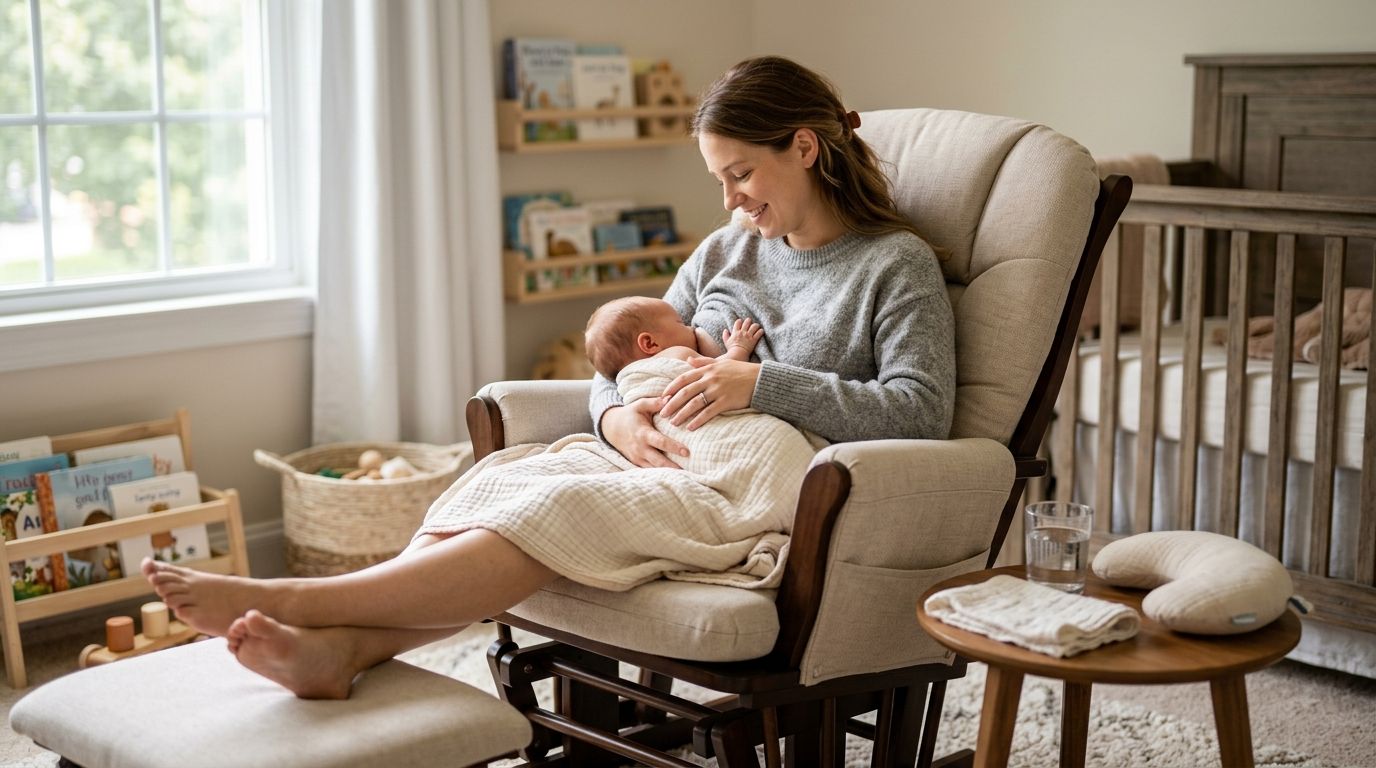
A glider rocking chair for nursing is a seat with a smooth, linear glide track (rather than a curved rocker base) built so a mother can feed a baby while moving gently back and forth without jostling the latch. Nursing mothers need something a standard rocking chair often can't give: a seat deep enough to support a nursing pillow, armrests at the right height for a supported arm during a 20-40 minute feed, and a glide quiet enough to use at 3 a.m. without waking anyone else in the house.
- A true glider rocking chair for nursing needs a linear glide track, 16-18 inch seat height, and armrests that support a nursing pillow.
- Dedicated nursery gliders work best for single-purpose feeding rooms; swivel accent chairs and swivel rocker recliners work better when the chair needs to double as living-room furniture.
- Test the glide motion in person before buying online only photos - a stiff or noisy track is the most common complaint from nursing mothers in 2026.
- Fabric that resists milk and spit-up stains matters more for this segment than for almost any other furniture buyer.
Why glider rocking chairs matter for nursing mothers
A newborn feeds 8 to 12 times in a 24-hour period during the first weeks, which means the chair a mother picks gets more daily use than almost any other piece of furniture in the house. During the typical 6-8 week postpartum recovery window, hip and lower back strain from a poorly angled seat compounds recovery, not just comfort.
This is a different buying problem than furnishing a living room. The chair has to support a static, seated posture for long stretches, hold up to spit-up and milk stains, and glide quietly enough that motion doesn't interrupt a sleeping baby. General furniture retailers rarely test for any of that - they test for looks. Edward Creation carries rocking and swivel-style seating built around motion and posture support, which is the same underlying design problem nursing chairs solve, even though the catalog isn't marketed as a dedicated baby-nursery line.
How to choose the right glider for nursing
Measure your room and your routine
Before anything else, know where the chair lives and how it needs to move. A glider that's perfect in a spacious nursery can crowd a small apartment room, and a chair that needs to migrate to the living room after weaning has different requirements than one staying in the nursery for years.
- Measure the floor space where the chair sits, plus 12-18 inches of clearance for the glide swing
- Note doorway width if the chair needs to move between rooms later
- Decide whether the chair needs to double as living-room seating after nursing ends
- Check ceiling height if a tall-back glider is in the running
- Confirm the room has an accessible outlet nearby if a power recliner is on the shortlist
If the room is tight, sizing a chair for a small room matters more here than in almost any other purchase, since a glider that's too wide blocks the crib or changing table.
Test the seat depth and height in person
Seat depth and height decide whether feet stay flat on the floor and whether a nursing pillow sits at the right level. A seat that's too deep pushes the lower back away from support; too shallow and the thighs lack support during a long feed.
- Aim for a seat height in the 16-18 inch range so feet rest flat without a footstool
- Sit for at least 10 minutes in-store or during a return window, not 30 seconds
- Check that the seat depth leaves 2-3 inches between the back of the knee and the front edge
- Confirm the backrest supports the lower back through a full recline, not just upright
- Bring the nursing pillow you actually use to test the fit
Check the glide mechanism for silence and control
The glide track is what separates a true glider from a standard rocker. A stiff, jerky, or squeaky glide is the single most common complaint nursing mothers report about nursery chairs bought sight unseen online.
- Push the chair through a full glide cycle and listen for squeaks or catches
- Check whether the glide locks in place for safe transfers in and out
- Confirm the motion is smooth at both slow and fast rocking speeds
- Test the glide with weight shifted to one side, since feeding rarely happens perfectly centered
Chairs built around gentle, controlled motion aren't unique to nursery furniture - the same mechanism shows up in seating designed for gentle motion rocking chairs marketed for comfort and joint relief, which is a useful reference point for what a well-built glide should feel like.
Match armrest height to your nursing pillow
Armrest height decides whether the supporting arm rests naturally or has to hover, which matters over a 20-40 minute feed repeated 8-12 times a day. Armrests that sit too low force the shoulder to drop and round forward; too high and the elbow strains upward.
- Measure the height of your nursing pillow when seated and match armrest height to it
- Check that armrests are padded, not hard plastic or bare wood
- Confirm armrest width supports the full forearm, not just the wrist
- Test with the baby's actual feeding position, not just an empty lap
Choose fabric that resists milk and spit-up stains
Fabric choice matters more for this segment than for almost any other furniture buyer, because the chair takes daily contact with milk, spit-up, and frequent wipe-downs. A porous fabric that looks fine in the showroom shows stains within weeks of regular feeding use.
- Pick performance fabric or treated microfiber over untreated cotton or linen
- Avoid light colors unless the fabric is stain-resistant by design
- Confirm removable, washable cushion covers if available
- Check that the fabric doesn't trap heat during long feeding sessions
Consider swivel and recline features for versatility
A chair that swivels lets a mother turn toward a changing table or crib without standing up, and a slight recline takes pressure off the lower back during longer feeds. These features aren't standard on every glider, so decide early whether they're worth the extra bulk.
- Confirm the swivel radius doesn't require more clearance than the room allows
- Check recline angle range and whether it locks at multiple positions
- Decide if a power recline is worth the added weight and cord management
- Test whether swivel motion is smooth under a baby's weight, not just empty
Smaller households often solve the swivel-plus-recline problem with chairs built for tight footprints, like the styles reviewed for swivel recliners for small living rooms, since the same space-saving logic applies to a nursery.
Budget for accessories and long-term use
A glider rarely arrives with everything a nursing routine needs. Plan for a nursing pillow, a small side table for water and burp cloths, and possibly a matching ottoman before the chair even arrives.
- Add a side table within arm's reach for water, phone, and burp cloths
- Decide if an ottoman or footstool is needed for full leg support
- Check if the chair fits through doorways for future moves
- Confirm whether the chair works as regular living-room seating once nursing ends


A dedicated nursery glider still wins on feed-specific ergonomics, but a swivel accent chair or swivel rocker recliner is a reasonable substitute for a family that needs the seat to work in more than one room after nursing ends.
Comparing glider and rocking chair options for nursing mothers
| Option | Best for | Key limitation |
|---|---|---|
| Dedicated nursery glider | Parents who want one chair built solely for feeding | Bulky, hard to repurpose once nursing ends |
| 360° Swivel Accent Chair | Small nurseries where the chair later moves to another room | No true glide track, so motion feels less linear than a dedicated glider |
| Luna Swivel Rocker | Mothers wanting heat and massage support during postpartum recovery | Heavier and bulkier, harder to move between rooms |
| Secondhand or budget rocking chair | Budget-conscious buyers | No warranty, inconsistent glide quality, may need reupholstering |
Verdict: a dedicated glider wins on pure nursing ergonomics, but for a family furnishing one flexible room in 2026, the swivel accent chair or swivel rocker recliner earns a Buy for versatility and a Hold on feed-specific armrest height until tested in person.
Common mistakes nursing mothers make when choosing a glider
- Buying on looks alone - a glider that photographs well can still have a stiff, noisy glide track that shows up only after delivery.
- Skipping the in-person test - 30 seconds in a showroom or a photo online doesn't reveal seat depth or armrest height problems that show up after a 30-minute feed.
- Ignoring fabric durability - light, untreated fabric stains within weeks of daily milk and spit-up contact.
- Forgetting future use - a chair sized only for the nursery becomes a problem once the baby outgrows the room and the chair needs to move.
- Underestimating armrest height mismatch - a chair that fits an empty lap often doesn't fit once a nursing pillow and baby are added.
FAQ
What is the difference between a glider and a regular rocking chair?
A glider moves on a linear track for a smooth back-and-forth motion, while a regular rocking chair pivots on a curved base. Gliders are generally preferred for nursing because the motion is smoother and quieter for a sleeping baby.
What seat height works best for a nursing chair?
A seat height in the 16 to 18 inch range keeps feet flat on the floor without a footstool for most adults. Taller or shorter users should test in person since a mismatch strains the lower back during long feeds.
Is a swivel accent chair a good substitute for a nursery glider?
A swivel accent chair works as a substitute when the room needs to double as regular living space after nursing ends, though it lacks the linear glide track a dedicated nursery chair provides. It trades feed-specific motion for room flexibility.
How much does a glider rocking chair for nursing cost in 2026?
Pricing varies widely by brand, fabric, and features like power recline or heat and massage, so check current listings on the retailer's site rather than relying on a fixed figure.
Does fabric choice matter for a nursing chair?
Fabric choice matters significantly because the chair takes daily contact with milk and spit-up. Performance fabric or treated microfiber resists stains far better than untreated cotton or linen.
Can a power recliner work as a nursing chair?
A power recliner with swivel and recline can work for nursing if the armrest height and seat depth fit a nursing pillow, though it's typically heavier and bulkier than a dedicated glider. It adds heat and massage options a standard glider doesn't offer.
How long should I test a glider before buying?
Sit for at least 10 minutes with the same nursing pillow used at home, not just a quick 30-second sit in a showroom. A short test misses seat depth and armrest issues that surface during a real feed.
One last thing
The detail nursing mothers skip most often isn't the fabric or the price - it's testing the glide with weight shifted to one side, since feeding almost never happens perfectly centered in the seat. A chair that glides smoothly empty can still catch or stutter once a baby and a nursing pillow throw the balance off, and that's the exact moment a squeaky track wakes a baby who just fell asleep.