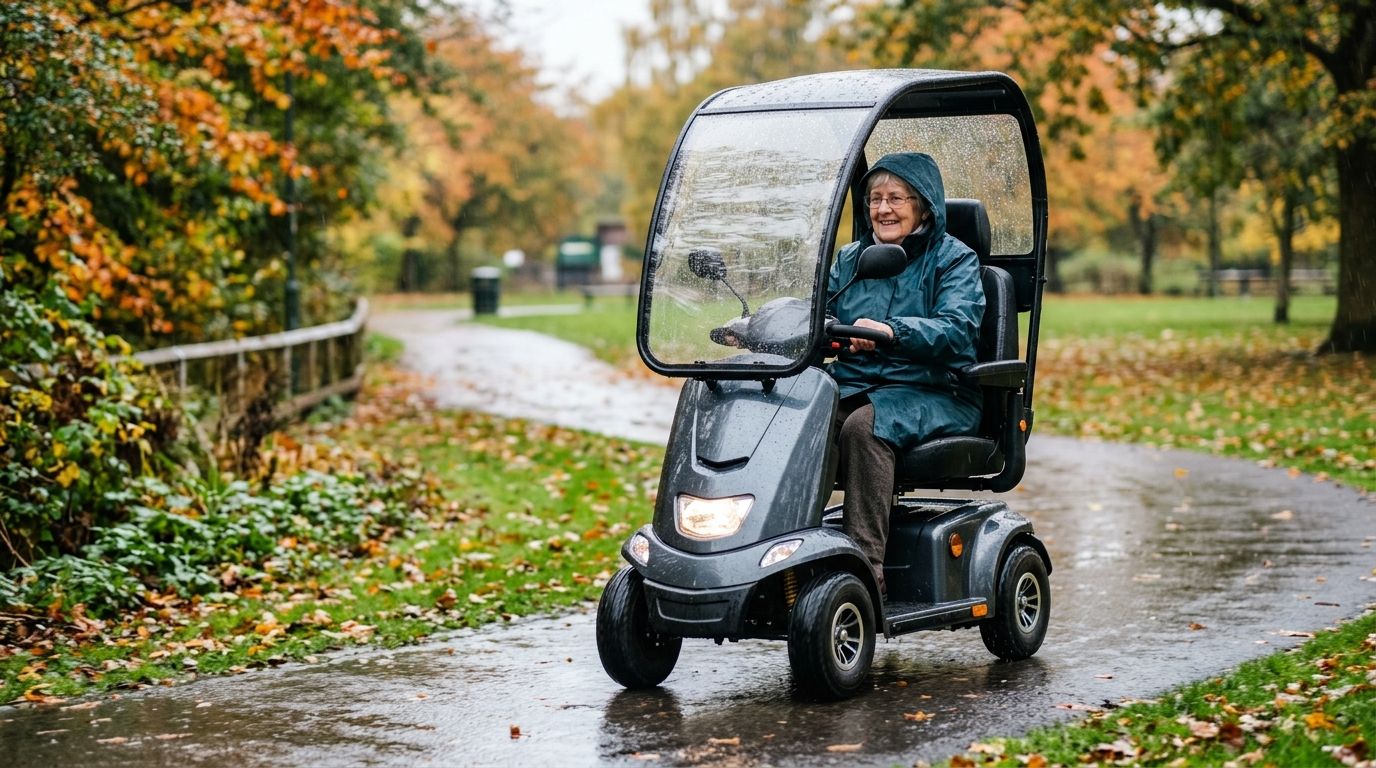
Rain doesn't have to end a mobility scooter routine, but it does change which scooter, which route, and which habits keep you safe and dry in 2026. A mobility scooter for rain is a standard mobility scooter chosen and maintained specifically to handle wet pavement, splash exposure, and reduced traction, with the goal of keeping riders independent on grocery runs, medical appointments, and neighborhood walks even when the forecast turns bad. Riders in this segment aren't shopping for an all-terrain machine — they're shopping for confidence that a normal errand won't strand them in a downpour with a dead battery or a fogged-up tiller display.
- No consumer mobility scooter is fully waterproof in 2026 — most electronics tolerate light rain and splashing, not submersion.
- A mobility scooter for rain needs a seat cover, a tiller/control panel cover, and a dry storage routine after every wet ride.
- Three-wheel scooters lose stability faster on wet pavement than four-wheel models; traction matters more than speed in the rain.
- Edward Creation's mobility scooter guides cover storage, transport, and grocery-run scooters that pair with rain-ready habits below.
- Skip the ride if visibility or lightning risk is high — no scooter feature replaces that judgment call.
Why mobility scooters for rain matter for this segment
Riders who depend on a scooter for daily errands can't just wait out a storm the way a car owner can — canceling a grocery trip or a pharmacy pickup because of drizzle isn't a minor inconvenience, it's a missed refill or an empty fridge. That's the gap this segment is searching to close: not "can I ride in a hurricane" but "can I trust this scooter on a wet sidewalk without it stalling out or throwing an electrical fault."
The honest answer is that most mid-priced mobility scooters handle light-to-moderate rain fine if the rider takes a few precautions, and struggle badly with standing water, heavy downpours, or repeated soakings without proper drying. That distinction — tolerance versus true weatherproofing — is the one manufacturers rarely spell out clearly, which is why this guide treats it as the central decision point.
Check the scooter's weather rating before you buy
Start here, because everything else in this guide assumes you already know what your scooter can and can't handle.
- Look for an IP (Ingress Protection) rating in the owner's manual or spec sheet — IPX4 or higher indicates splash resistance, not submersion resistance.
- Ask directly whether the battery compartment, tiller wiring, and motor housing are sealed or just shielded.
- Note the scooter's ground clearance — low clearance means puddles reach the motor housing sooner.
- Confirm whether the seat cushion and control panel are covered under warranty for water damage, since most standard warranties exclude it.
- If you're shopping new in 2026, ask the retailer for the manufacturer's written weather guidance rather than relying on marketing copy.
If you already own a scooter and don't know its rating, treat it as unrated and add every precaution below rather than assuming it's protected.
Waterproof the electrical components you already own
Before buying anything new, work with what's already on the scooter.
- Wrap exposed wiring joints near the battery compartment with self-fusing silicone tape, not standard electrical tape, which degrades faster when wet.
- Add a snap-on tiller cover over the display and controls — this is the single most common failure point when riders report electrical faults after rain.
- Check that the charging port has a rubber flap or plug and keep it closed whenever the scooter isn't charging.
- Inspect battery terminals monthly for corrosion, which spreads faster with repeated damp exposure.
A fitted rain and cargo-ready three-wheel scooter picked with weather resistance in mind from day one removes most of this maintenance burden, but the tape-and-cover approach above works on almost any scooter already in a garage.
Plan routes and timing around the rain, not through it
Riding technique matters as much as equipment once pavement gets wet.
- Check hyperlocal radar 15-20 minutes before leaving, not just the daily forecast, since scooter trips are short enough that a 20-minute gap in rainfall is usually enough.
- Favor covered sidewalks, awnings, and parking structure routes over open plazas when a route option exists.
- Slow to roughly half normal speed on painted crosswalk lines, metal grates, and leaf-covered pavement — these are the surfaces where wet-weather scooter falls concentrate.
- Avoid curb cuts with standing water; motors and undercarriage electronics sit closest to the ground exactly where puddles pool.
- Build a 10-15 minute buffer into errands so you're not tempted to push through worsening rain to make a scheduled stop.
Protect the seat and controls between rides
Water sitting on the seat or console does more long-term damage than water hitting it briefly during a ride.
- Use a fitted vinyl or nylon seat cover any time the scooter is parked outdoors, even under an awning.
- Keep a microfiber cloth in the scooter's basket or bag specifically for wiping the tiller display before and after use.
- If the scooter sits outside overnight, a full-body scooter cover cuts moisture exposure dramatically compared to no cover at all.
- Dry the underside of the seat cushion separately from the frame — trapped moisture there causes mildew faster than exposed surfaces.
Dry and store the scooter properly after every wet trip
This step gets skipped more than any other, and it's the one most tied to long-term reliability.
- Wipe down the frame, wheels, and battery compartment with a dry towel immediately after coming inside, not after the scooter sits for an hour.
- Leave the battery compartment cover open (if the design allows) for 20-30 minutes indoors to let trapped moisture evaporate before closing it back up.
- Store the scooter somewhere with airflow rather than a sealed closet, which traps humidity against the frame.
- If storage space is tight, a scooter sized for compact indoor storage still needs a dry, ventilated spot — not just a small one.
Match tire tread to wet pavement
Tires get overlooked in rain-readiness conversations, but they're doing the actual work of keeping the rider upright.
- Solid or foam-filled tires resist punctures but generally offer less wet-traction grip than pneumatic tires with tread designed for water displacement.
- Check tread depth monthly during rainy seasons — worn tread on a scooter behaves like bald tires on a car, with grip loss concentrated on turns.
- Clean tire grooves of dirt and debris after wet rides, since packed mud reduces the tread's ability to channel water.
- Four-wheel scooters distribute weight more evenly across wet pavement than three-wheel models, which lean into turns and lose stability faster when the surface is slick.
Plan for reduced range and battery care in cold, wet weather
Cold rain hits battery performance harder than dry cold, and riders in this segment consistently underestimate the range drop.
- Charge fully before any trip where rain and cold overlap — battery output drops in low temperatures regardless of weather rating.
- Avoid letting the battery sit at low charge in a cold, damp garage overnight; partial charge plus cold plus moisture is the combination that shortens battery lifespan fastest.
- Carry a charged spare battery on longer wet-weather errands if the scooter model supports a swappable pack.
- Know your scooter's real-world range in cold weather, not the manufacturer's ideal-conditions number, and plan trips with margin.
Know when to skip the ride entirely
No cover, tape, or tire upgrade replaces judgment on the worst days.
- Skip the trip during thunderstorms — lightning risk on an open-air scooter is a genuine hazard, not a minor inconvenience.
- Skip it when visibility drops below normal walking distance, since scooter riders sit lower and are harder for drivers to see in heavy rain.
- Skip it on days with flash flood warnings, even for short trips, because standing water depth is unpredictable at curb level.
- If a trip truly can't wait, arrange for safe transport of the scooter by car instead of riding it through the worst conditions.
“If the rain is heavy enough to close an umbrella, it's heavy enough to park the scooter.”
Comparing rain-readiness options for this segment
| Option | Best for | Key limitation |
|---|---|---|
| Four-wheel scooter with fitted covers | Riders prioritizing wet-pavement stability | Wider turning radius, harder to store in tight spaces |
| Three-wheel scooter with rain accessories | Riders needing tighter indoor maneuverability | Less stable on wet, uneven, or sloped surfaces |
| Standard scooter plus aftermarket seat/tiller covers | Owners not ready to replace an existing scooter | Covers protect surfaces, not internal wiring |
| Scooter kept for dry-day use only, car for wet-day errands | Riders in areas with frequent heavy storms | Requires a transport-ready loading setup and a second driver in some cases |
Common mistakes this segment makes
- Assuming "weather-resistant" means waterproof — most scooter listings use resistant language loosely, and riders find out the difference the expensive way after a fault.
- Skipping the drying step because the ride felt short — even a five-minute wet trip leaves moisture in seams and joints if the scooter isn't wiped down.
- Riding through standing water at intersections — curb-level puddles are deeper than they look and sit exactly where undercarriage electronics are most exposed.
- Ignoring tire tread until traction actually fails — by the time a rider notices slipping, the tread has usually been marginal for months.
- Storing the scooter wet in a sealed space — this traps humidity against the frame and accelerates corrosion faster than leaving it briefly exposed to open air.
FAQ
Is there a fully waterproof mobility scooter for rain in 2026?
No consumer mobility scooter on the market in 2026 is fully waterproof — most are splash-resistant at best, meaning light rain and wet pavement are fine but submersion or standing water is not. Check the IP rating before assuming otherwise.
Can I ride my mobility scooter in light rain?
Yes, most scooters handle light rain fine as long as the seat, tiller, and battery compartment are covered and dried afterward. Heavy rain, standing water, and thunderstorms are where the real risk starts.
What happens if a mobility scooter gets wet electronics?
Wet electronics typically cause intermittent faults first — a flickering display or unresponsive controls — before failing completely. Drying the compartment promptly and avoiding repeated soaking prevents most long-term damage.
Are three-wheel or four-wheel scooters better in the rain?
Four-wheel scooters generally handle wet pavement more stably because weight is distributed across four contact points instead of three. Three-wheel scooters offer a tighter turning radius but lean more into turns, which reduces grip on slick surfaces.
Do mobility scooter batteries perform worse in rain?
Cold, damp conditions reduce battery output more than rain exposure alone, so riders often see shorter range on wet, cool days. Charging fully before the trip and avoiding storage at low charge in cold, damp spaces protects battery life.
How do I protect a mobility scooter from rain damage?
A fitted seat cover, a tiller/control panel cover, and a thorough dry-down after every wet ride cover most of the risk. Sealing wiring joints and keeping the charging port covered when not in use handles the rest.
Should I buy rain covers or a new weatherproof scooter?
If the current scooter is otherwise in good shape, aftermarket seat and tiller covers plus good drying habits solve most rain problems without a new purchase. A new scooter only makes sense if the existing model has no splash resistance at all or the electrical compartment is already compromised.
Is it safe to store a mobility scooter outdoors in the rain?
Extended outdoor storage without a full-body cover accelerates corrosion and moisture damage, even under an awning. A ventilated indoor or covered storage spot with a fitted cover is the safer default.
One last thing
The detail most riders miss isn't the scooter at all — it's the charging port. A charging port left uncovered during a single unexpected shower does more electrical damage over a season than dozens of short, properly-dried rides in light rain, because water sits directly against the contacts instead of just splashing the frame. Cover that one port and dry it after every trip, and most of the rain-related failure risk on a mobility scooter disappears before it starts.