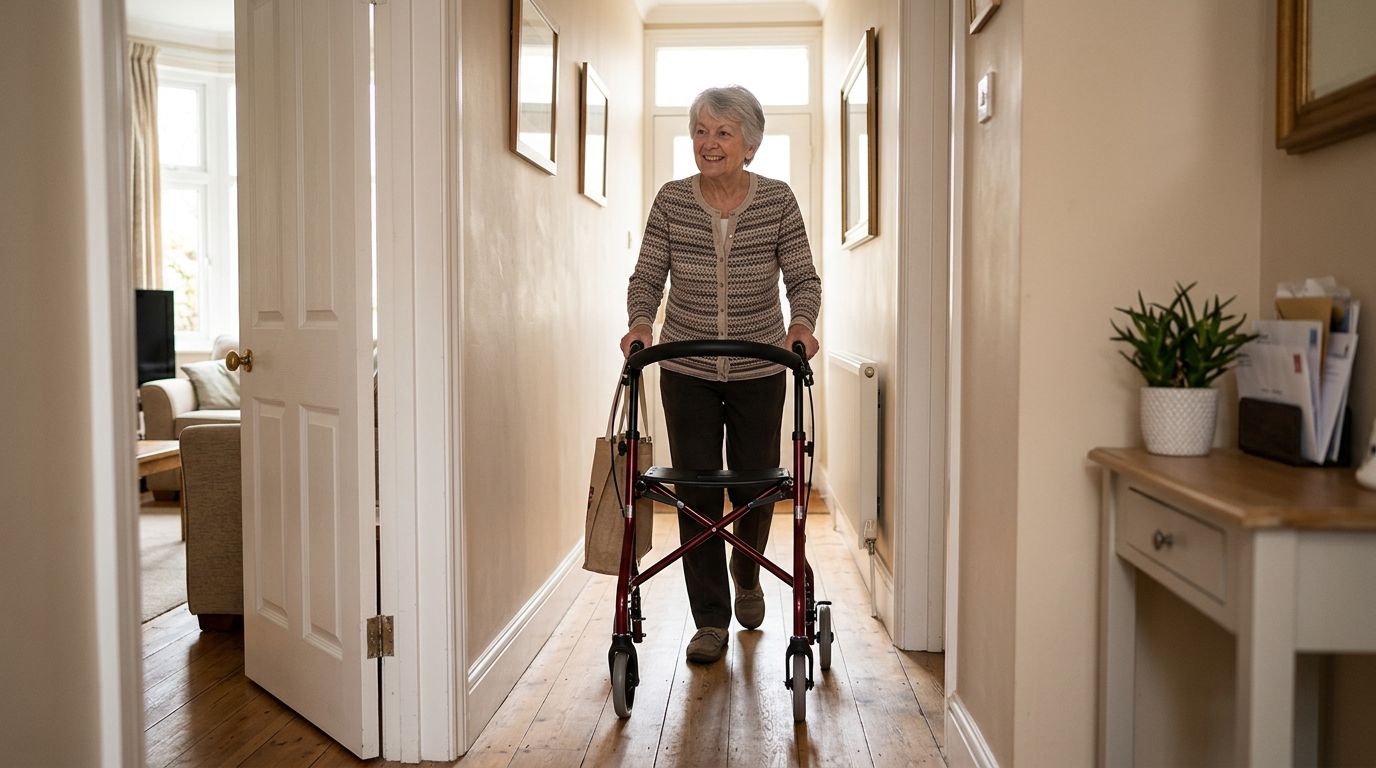
Choosing the right rollator for a narrow hallway comes down to frame width and turning radius, not brand names. The best rollator walker for a narrow hallway is a three-wheel model for the tightest turns, a narrow-frame four-wheel rollator when you need a seat, and an upright posture rollator for anyone who leans forward while walking. Each solves a different hallway problem, and picking the wrong type means scraped walls, stuck wheels, or a walker that won't fold to fit through a closet door.
- Three-wheel rollators win for the tightest hallway turns because they need the smallest turning radius.
- Narrow-frame four-wheel rollators run about 21 to 23 inches wide and still fold out to a seat.
- Upright posture rollators suit anyone who leans forward, but they trade off some turning ease.
- Compact folding rollators matter most in small apartments where storage space is the real constraint.
- Most interior hallway doorways measure 27 to 32 inches, so anything wider than 25 inches is a gamble.
Why this matters
A rollator that's too wide for your hallway isn't a minor inconvenience — it's a fall risk. Every time a wheel catches a doorframe or baseboard, the user has to correct balance mid-stride, which is exactly the moment falls happen. If you're already researching fall prevention at home for aging parents, hallway clearance for mobility aids belongs on that checklist right next to grab bars and lighting.
Most interior doorways in homes built before 2026 run 27 to 32 inches wide, and older houses can go tighter. A standard rollator at 25 to 27 inches wide leaves almost no margin. A narrow-frame model at 21 to 23 inches gives you 4 to 6 inches of breathing room on each pass through a doorway, which matters more than any accessory or color option.
What makes the best rollator walker for narrow hallways
- Overall frame width — narrower is safer for doorways and hall runners, period.
- Turning radius — three-wheel designs pivot in less space than four-wheel frames.
- Stability during turns — a wider wheelbase resists tipping but costs you hallway clearance.
- Fold profile — how flat and how narrow the rollator collapses for storage near an entryway.
- Seat availability — some narrow designs skip the seat entirely to save width.
- Weight capacity vs. width — heavier-duty frames often widen the base, which works against narrow-hallway use.
Rollator types for narrow hallways at a glance
| Type | Best for | Standout feature | Key limitation |
|---|---|---|---|
| Three-wheel rollator | Tight turns in narrow hallways | Smallest turning radius of any rollator style | No seat, less side-to-side stability |
| Narrow-frame four-wheel rollator | Stability with a place to rest | Seat included at a trimmed 21-23 inch width | Wider turning radius than three-wheel models |
| Upright (posture) rollator | Users who lean forward while walking | Forearm supports keep posture upright | Bulkier frame in some models, less nimble in corners |
| Compact folding rollator | Small apartments and easy storage | Folds flat for closet or corner storage | Lighter frames sometimes sacrifice stability outdoors |
| Bariatric narrow-frame rollator | Larger-frame users needing width capacity | Reinforced frame in a trimmed footprint | Fewer narrow options at higher weight capacities |
1. Three-wheel rollator: best for tight turns in narrow hallways
A three-wheel rollator drops the rear axle down to a single wheel, which shrinks the turning radius dramatically compared to four-wheel frames. That's the entire reason it exists for narrow-hallway use: it pivots where a four-wheel model would need to back up and re-angle.
Three-wheel rollator pros:
- Smallest turning radius of any rollator category
- Lighter overall frame, easier to maneuver one-handed
- Narrower footprint fits doorways under 25 inches with room to spare
Three-wheel rollator cons:
- No seat on most designs, so there's nowhere to rest mid-walk
- Less stable on uneven flooring transitions than a four-wheel frame
- Some users find the tri-wheel base tips more easily on carpet edges
Best for: hallways with sharp corners or multiple doorways in a short stretch. Verdict: Buy if turning radius is your main problem and a seat isn't a requirement.
2. Narrow-frame four-wheel rollator: best for stability with a seat to rest on
This is the middle-ground option — a standard four-wheel rollator built on a trimmed frame, usually 21 to 23 inches wide instead of the standard 25 to 27 inches. You keep the seat and the wider wheelbase stability, at the cost of a slightly wider turn than a three-wheel model.
Narrow-frame four-wheel rollator pros:
- Built-in seat for rest stops, which three-wheel models skip
- More stable during turns than a three-wheel frame
- Fits most doorways in the 27 to 32 inch range comfortably
Narrow-frame four-wheel rollator cons:
- Wider turning radius than a three-wheel design
- Folded profile is bulkier for storage near an entryway
- Some narrow models trim seat width along with frame width
Best for: anyone who needs to sit down partway through a hallway walk, especially after a transfer from a wheelchair to a lift chair or a similar mobility routine at home. Verdict: Buy for most narrow-hallway households that also want a resting seat.
3. Upright (posture) rollator: best for users who lean forward while walking
An upright rollator moves the hand grips higher and adds forearm supports, so the user stands straighter instead of hunching over a low frame. It's built for posture, not for hallway width, but several models now come in trimmed frames too.
Upright rollator pros:
- Keeps the user's back and shoulders upright, reducing strain over long walks
- Forearm rests take pressure off wrists compared to standard hand grips
- Available in narrower frame widths on newer 2026 model lines
Upright rollator cons:
- Bulkier frame on some models than a standard three-wheel design
- Higher price tier generally than basic four-wheel rollators
- Less nimble in sharp corners than a three-wheel frame
Best for: users managing spinal stenosis, lower back pain, or general posture issues who also happen to live in a tight hallway. If back pain is the bigger concern day to day, it's worth comparing against lift chairs built for spinal stenosis and lower back pain as a complementary piece of equipment, not a replacement. Verdict: Hold — worth it if posture is the priority, otherwise a standard narrow-frame model does the hallway job for less.
4. Compact folding rollator: best for small apartments and easy storage
Some hallways are only half the problem — the other half is where the rollator lives when it's not in use. A compact folding rollator collapses flat enough to slide into a closet or stand behind a door, which matters in studio and one-bedroom units.
Compact folding rollator pros:
- Folds flatter and narrower than most standard rollators
- Lightweight enough to carry up a short flight of stairs
- Frees floor space in small entryways when not in use
Compact folding rollator cons:
- Lighter frames can feel less stable outdoors on uneven ground
- Smaller wheels handle thresholds and door sills less smoothly
- Weight capacity tends to run lower than heavier-duty frames
Best for: apartment living where storage space matters as much as hallway width. Verdict: Buy for apartment dwellers; Wait if the unit gets heavy outdoor use, since the tradeoff for foldability is a lighter build.
5. Bariatric narrow-frame rollator: best for larger-frame users needing width capacity
Most narrow rollators trim width by trimming weight capacity too. Bariatric narrow-frame models solve for both at once — reinforced frames that still fit tighter doorways, though the selection is smaller than in standard-capacity lines.
Bariatric narrow-frame rollator pros:
- Reinforced frame handles higher user weight than standard narrow models
- Still fits most doorways over 25 inches
- Seat and hand brakes rated for heavier daily use
Bariatric narrow-frame rollator cons:
- Fewer models to choose from than standard-width bariatric rollators
- Heavier frame overall, harder to fold and carry
- Turning radius is the widest of the five types here
Best for: larger-frame users who need both width capacity and hallway clearance. Verdict: Buy if you've confirmed the specific model's width against your doorway measurement — don't guess on this one.
How this list was ranked
Each type was measured against the six criteria above: frame width, turning radius, stability in turns, fold profile, seat availability, and the weight-capacity tradeoff. No two entries compete for the same use case — that's the point of ranking by scenario instead of by brand.
Which rollator walker should you choose?
Measure your narrowest doorway before anything else. If it's under 25 inches, a three-wheel rollator is the safest default for 2026 — it clears tight turns that four-wheel frames can't. If you need a seat for rest stops, step up to a narrow-frame four-wheel rollator instead. Everyone else should match the type to the specific problem: posture to upright models, storage to folding models, weight capacity to bariatric narrow-frame models.
If falls are the underlying worry rather than just hallway width, pair whichever rollator you choose with a broader look at fall prevention aids for seniors living alone — grab bars, lighting, and threshold ramps solve problems a rollator alone can't.
“If your rollator can't clear a 27-inch doorway with an inch to spare, you'll scrape walls every time you turn.”
FAQ
What's the best rollator walker for narrow hallways in 2026?
A three-wheel rollator is the best rollator walker for narrow hallways in 2026 because it needs the smallest turning radius of any rollator type. Narrow-frame four-wheel models are the next best option if you need a seat.
Is a three-wheel rollator better than a four-wheel rollator for tight spaces?
Yes, a three-wheel rollator turns in less space than a four-wheel rollator because it has a single rear wheel instead of a wider rear axle. The tradeoff is no seat and slightly less side-to-side stability.
How wide should a rollator be for a narrow hallway?
Look for a rollator frame between 21 and 23 inches wide if your hallway doorways measure less than 27 inches. Standard rollators run 25 to 27 inches wide, which leaves almost no clearance in tighter homes.
Do narrow rollators sacrifice stability compared to standard models?
Some narrow-frame rollators trim the wheelbase along with the width, which can reduce stability during turns. Narrow four-wheel models generally hold stability better than narrow three-wheel models because of the wider four-point base.
Can a narrow rollator still have a seat?
Yes, narrow-frame four-wheel rollators typically keep the seat while trimming overall width to around 21 to 23 inches. Three-wheel rollators usually skip the seat entirely to achieve their smaller turning radius.
What is an upright or posture rollator?
An upright rollator raises the hand grips and adds forearm supports so the user stands straighter instead of leaning over a low frame. It suits people managing back pain or posture issues, though it's not always the narrowest option.
How do I measure my hallway for a rollator?
Measure the narrowest doorway or hallway pinch point in inches, then subtract at least 2 inches for safe clearance on each side. Compare that number against the rollator's listed overall width, not the seat width, since the frame width is usually wider.
Should I get a wider rollator for extra stability in a narrow hallway?
No — in a narrow hallway, width creates more risk than it solves, since a wider frame is more likely to catch on doorframes and furniture. Prioritize a narrow-frame model and rely on the four-wheel base, not extra width, for stability.
One last thing
The measurement that actually matters is the narrowest pinch point in the whole route, not the average hallway width — a single tight doorway or a hall table sticking out 3 inches undoes a rollator that fits everywhere else. Walk the full path with a tape measure before ordering anything in 2026.