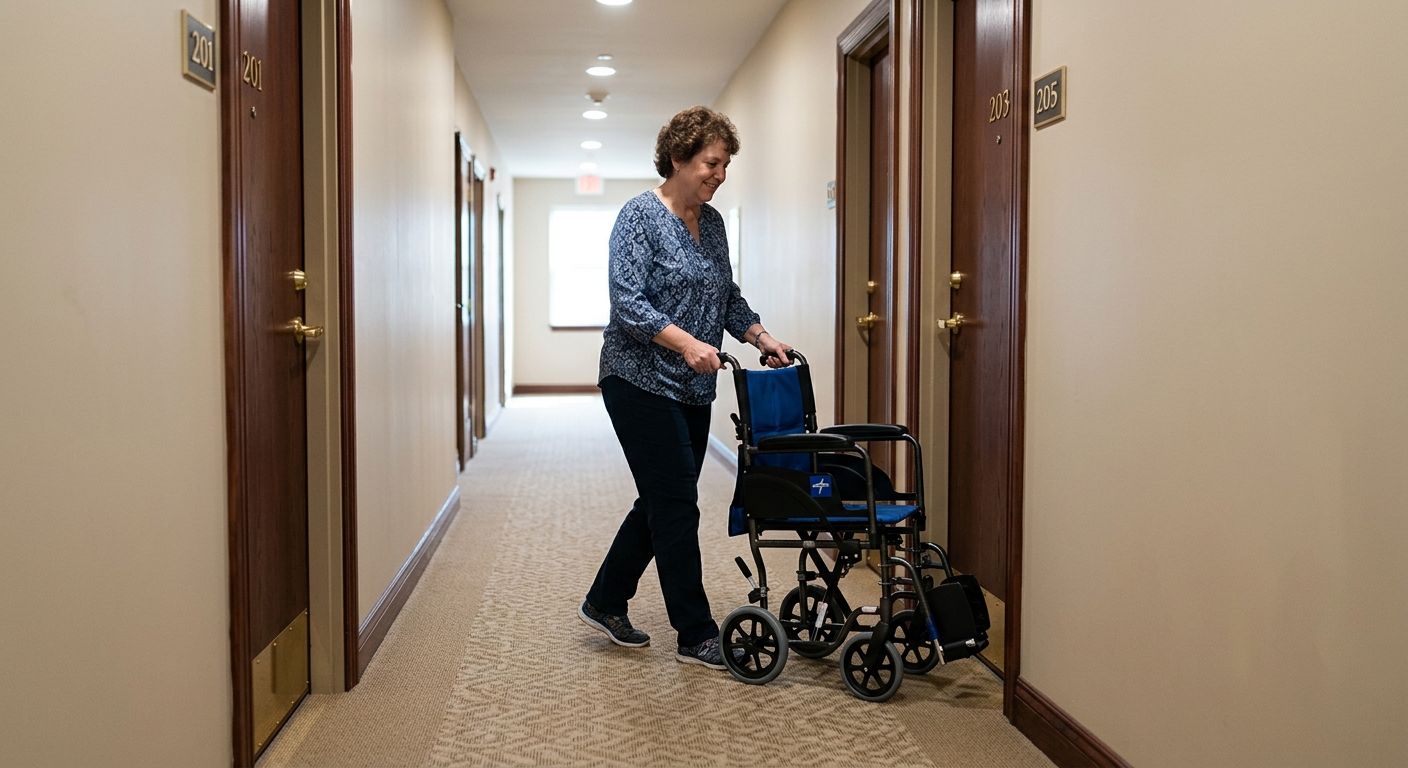
Apartment renters need a transport wheelchair for apartment hallways that's under 24 inches wide when open and folds to fit a coat closet, not a garage. The narrower the building, the less room there is for error between a doorframe, a mailroom cart, and a neighbor's welcome mat.
- A transport wheelchair for apartment use should measure under 24 inches wide open and fold flat for closet storage.
- ADA hallway minimums (36 inches) and doorway clearances (32 inches) set the baseline every apartment renter should measure against before buying.
- Lightweight aluminum frames under 25 lbs are the easiest for a single caregiver or resident to fold and lift alone.
- Mobility scooters solve outdoor errands but need a wider turning radius than a transport chair inside a narrow hallway.
Why transport wheelchairs matter for apartment living
A transport wheelchair bought for a house with wide hallways can be the wrong chair entirely once it's rolled into a building with 34-inch corridors and a shared elevator that fits two people and a laundry cart. Apartment residents deal with fixed architecture they can't renovate: narrow entry doors, tight turns at the mailroom, and elevators shared with everyone else on the floor.
The stakes are practical, not cosmetic. A chair that scrapes both walls on a turn wears down finish faster, irritates property managers, and slows down the resident using it every single trip to the elevator. Getting the width and fold-down size right the first time avoids a return, a refund request, and weeks of managing without a working chair in 2026.
Measure your hallway and doorway widths
Start with a tape measure before you look at a single transport wheelchairs for small cars listing. This step is free, takes ten minutes, and eliminates half the wrong purchases apartment shoppers make.
- Measure the narrowest hallway point, not the average width
- Measure the doorframe clearance at your unit's front door and any interior doors the chair needs to pass through
- Measure the elevator cab door and interior floor space if your building has one
- Note any radiators, thermostats, or fire extinguisher boxes that jut into the hallway
- Write down the smallest number you find — that's your hard limit, not a target
Check your building's turning radius
A hallway can be wide enough for a chair to pass straight through and still be too tight for a 90-degree turn at a corner or elevator bank. Turning radius trips up more apartment buyers than straight-line width does.
- Test the tightest corner on your floor with a tape measure or a borrowed chair before buying
- Ask your building manager if the freight elevator (if one exists) is available on request
- Account for door swing direction — some doors open into the exact path the chair needs
- Check whether the mailroom or lobby has a pinch point narrower than the main hallway
Choose a frame width that clears your narrowest point
Once you know the hard number from step one, shop against it directly. Most transport wheelchairs run 22 to 26 inches wide when open, and the difference between 22 and 26 inches decides whether a chair fits a 24-inch doorway or gets stuck.
- Confirm the open width, not just the folded width, on the product listing
- Subtract at least an inch of margin for wall texture, baseboards, and door hinges
- If every transport chair on your shortlist runs too wide, a compact mobility scooter built for small apartments may clear tighter turns better on straightaways, though it needs more room to pivot at corners
- Check the seat width separately from the frame width — a narrow frame can still have a wide seat that changes the outer dimension
Prioritize weight for one-person folding
Apartment living often means no second person around to help fold and lift a chair into a closet or a car trunk. Weight becomes the deciding factor almost as often as width does.
- Aluminum frames typically weigh 19 to 25 lbs, steel frames run 30 to 40 lbs
- A resident who folds and stores the chair solo should stay under 25 lbs whenever possible
- Check whether the fold mechanism needs two hands and a knee, or a single one-hand latch
- Confirm the folded dimensions fit your actual closet or under-bed clearance, not just "compact" marketing language
Test the fold before you commit
A chair that folds smoothly in a showroom video can behave differently after six months of daily use in a hallway with carpet transitions and thresholds. Test this before the return window closes.
- Fold and unfold the chair at least five times in the space you'll actually use daily
- Check that wheels lock securely when folded so it doesn't roll open in a closet
- Confirm the chair stands upright on its own when folded, so it doesn't need to lean against drywall
- Watch for pinch points near hinges if children or pets share the apartment
Plan storage inside a small footprint
A folded transport wheelchair still needs a dedicated spot, and apartment square footage doesn't leave much slack. Planning this before delivery day avoids a chair parked permanently in the hallway, which creates its own tripping hazard.
- Measure the closet depth, not just the width, since some folded chairs are deeper than expected
- Consider a slim vertical spot behind a door rather than floor space in a living area
- Pair the storage plan with broader fall prevention aids for aging parents if the same apartment has other mobility equipment competing for space
- If storage is genuinely tight, prioritize chairs under 12 inches folded depth
Comparison: transport wheelchair options for apartment hallways
| Option | Best for | Key limitation |
|---|---|---|
| Standard steel transport wheelchair | Caregivers pushing over short distances daily | Heavier frame (30-40 lbs) is harder to fold solo |
| Lightweight aluminum transport wheelchair | Residents folding and storing the chair alone | Lower weight capacity, often under 250 lbs |
| Transport wheelchair with removable armrests | Tight bathroom and kitchen doorways under 24 inches | Armrests must be reinstalled each use and can go missing |
| Compact mobility scooter | Residents who also need independent outdoor trips | Needs a wider turning radius than a transport chair on hallway corners |
| Transport wheelchair for air travel | Renters who travel frequently and need one chair for both | Built for airline gate-checking, so it trades some hallway agility for travel durability |
A lightweight aluminum transport wheelchair under 25 lbs is the strongest default for most apartment hallways in 2026 — it clears standard doorways, folds thin enough for a closet, and one person can manage it without help.
Common mistakes apartment renters make
- Buying by seat width alone. The overall frame width including wheels is what actually decides whether the chair clears a doorframe, and sellers rarely lead with that number.
- Assuming the freight elevator is always available. Many buildings require advance booking, which matters on a day the resident needs to leave immediately.
- Storing the folded chair against a fire door. This blocks egress and violates most lease agreements, even when the hallway looks empty.
- Skipping the turning-radius test at the sharpest corner. A chair that passes a straight hallway test can still jam at the one 90-degree turn to the elevator.
- Choosing casters too small for door thresholds. Small front casters catch on raised thresholds and carpet transitions, causing a stop-and-jerk motion that's uncomfortable for the rider.
Edward Creation's product range leans toward lift chairs, recliners, and mobility scooters rather than transport wheelchairs specifically, so the apartment-fit math above applies whether the final purchase is a dedicated transport chair or a compact scooter sized for the same hallway.
FAQ
What's the best transport wheelchair for apartment hallways in 2026?
A lightweight aluminum transport wheelchair under 25 lbs and 22-24 inches wide open is the best fit for most apartment hallways in 2026. It clears standard 32-inch doorframes with margin and folds thin enough for closet storage.
How narrow can a transport wheelchair be?
Most transport wheelchairs run 22 to 26 inches wide when open. Removable-armrest models can shave an inch or two off that for the tightest bathroom and kitchen doorways.
Is a transport wheelchair better than a mobility scooter for apartments?
A transport wheelchair generally handles tight hallway corners better because it has a smaller turning radius than a scooter. A mobility scooter fits residents who also need independent outdoor trips and can tolerate a wider turn at corners.
How much does a transport wheelchair weigh?
Aluminum-frame transport wheelchairs typically weigh 19 to 25 lbs, while steel-frame models run 30 to 40 lbs. Solo apartment residents folding the chair alone should stay under 25 lbs.
Can a transport wheelchair fit in a standard elevator?
Most transport wheelchairs fit standard passenger elevators, but the tighter risk is the turn from the hallway into the elevator door, not the elevator cab itself. Measure the corner turn, not just the cab dimensions.
What's the difference between a transport wheelchair and a rollator?
A transport wheelchair is pushed by a second person and the rider sits the entire time, while a rollator is a walking aid the user pushes themselves while standing. They solve different mobility needs and aren't interchangeable.
Does ADA hallway width apply to apartment buildings?
ADA minimum hallway width (36 inches) and doorway clearance (32 inches) apply to common areas in many multi-family buildings, but individual unit interiors can vary by building age and code at construction. Measure your own hallway rather than assuming compliance.
How do I store a transport wheelchair in a small apartment?
Measure closet depth as well as width, since folded chairs vary more in depth than in height. A slim vertical spot behind a door works better than floor space in a living area for most one-bedroom layouts.
One last thing
The number that trips up the most apartment buyers isn't the chair's open width — it's the folded depth, which sellers list less consistently than width or weight. Ask for that exact figure before ordering in 2026, because a chair that's narrow enough for the hallway but too deep for the closet just moves the storage problem from one room to the next.